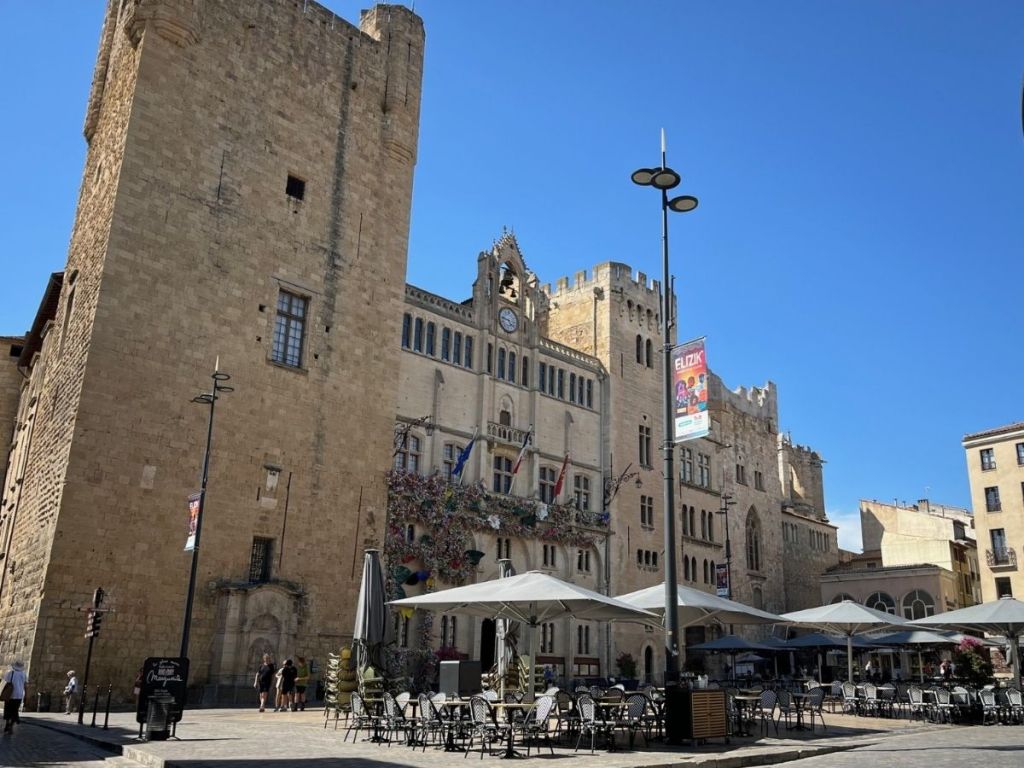
Narbonne, in the South of France, has a history far greater than what first meets the eye. Its Roman past survives beneath the streets, while the medieval city unfolds around the imposing Archbishop’s Palace and cathedral. Add an inhabited bridge, a lively covered market, a canal lined with plane trees, and the birthplace of one of France’s most beloved singers, and you have a city where centuries of history, culture, and Mediterranean life come together.
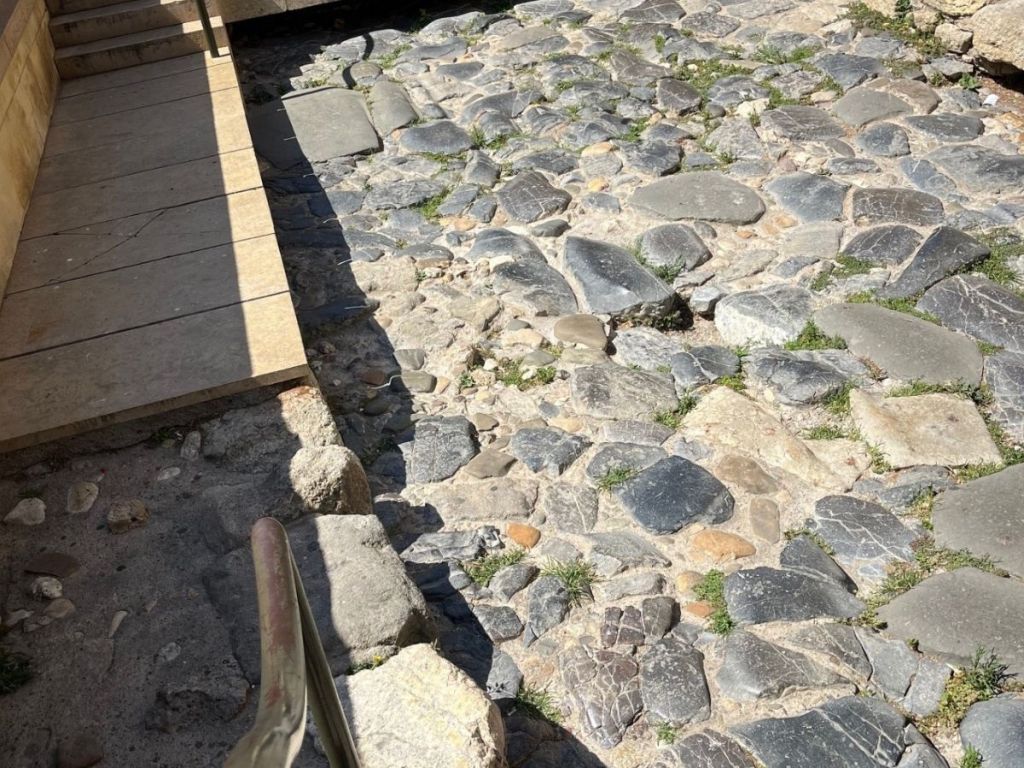
A stretch of the Via Domitia in front of Narbonne’s town hall. ©Algoma
Narbonne, the “Eldest Daughter of Rome”
During the Antiquity, Narbonne was the heart of a vast territory known as Narbonensis, which stretched across southern France from the Pyrenees to the Montgenèvre Pass in the Alps.
Discover its story
One of the finest remnants of this ancient history lies in the city center: an open section reveals a stretch of the Via Domitia right in front of the current town hall. Dating back to the late 2nd century BC, this road—which we also encounter notably in Nîmes and Béziers—linked Italy to Spain. In Nîmes, one might recall, it made a right-angle turn at the Maison Carrée. In Narbonne, it still defines the line of the “Rue Droite” (Straight Street) today and spans the former bed of the Aude River via the Pont des Marchands.
Narbonne also boasts vast Roman galleries that wind underground through the heart of the city, their true purpose shrouded in mystery. Were they warehouses? The foundations—cellars or crawl spaces—of a Roman structure? A private residence? A public building? A market? The question remains unanswered.
At the Clos de la Lombarde, in the northern part of the city, excavations have revealed an entire block of Roman structures dating from the 1st century BC to the 3rd century AD. Here, the stones (and the guides) tell the story of a buried, sophisticated, and wealthy civilization—where houses featured mosaic floors and wall frescoes, where wastewater and rainwater management rivaled our own ingenuity, and where Christianity even laid the foundations of an Early Christian basilica.
And that is just about it.
Of Narbo Martius—that premier Roman colony founded in the late 2nd century BC and capital of Gallia Narbonensis—little remains but ruins yet to be unearthed. Situated where the Aude River opened onto the sea, it was once one of antiquity’s most prosperous ports—reputedly the second most important in the Western Mediterranean after Rome—and a hub of intense commercial activity. Gone is the amphitheater that could have rivaled those still standing in Nîmes, Arles, or Orange; vanished is the monumental Carrara marble temple; and buried beneath the re-channeled river are the arches of the bridge that once spanned the Aude…
Once a “daughter of Rome,” the city has since lost most of its ancient remains and much of its former prestige. Yet, for anyone who appreciates the beauty of craftsmanship revealed in fragments of the past, the Narbo Via museum splendidly showcases the city’s lapidary heritage.
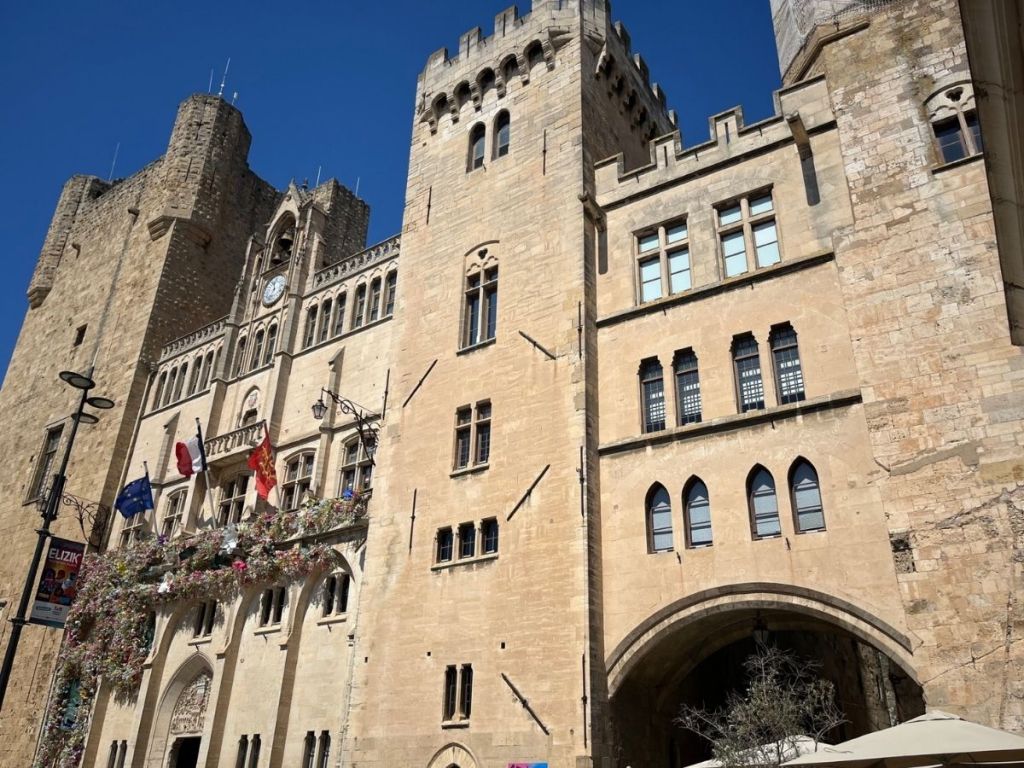
The Neo-Gothic façade of the Archbishop’s Palace, flanked by the Gilles Aycelin keep and the Saint-Martial Tower. ©Algoma
Narbonne, Medieval Capital
While almost nothing remains above ground of the powerful ancient city of Narbo Martius, the same cannot be said for the medieval city. In fact, it is the medieval city that welcomes you at the very heart of Narbonne, on the Place de l’Hôtel de Ville, where you will find the Archbishop’s Palace and the Cathedral of Saint-Just and Saint-Pasteur.
Discover its story
Getting there couldn’t be simpler: just take Rue Droite, a street that follows the original route of the Via Domitia. (Isn’t it amazing to think that you are walking the same paths as the men and women of antiquity? —even if the scenery is, of course, quite different ;)).
Following this route brings you to a pleasantly proportioned rectangular square, majestically framed by the Archbishop’s Palace, the Pont des Marchands spanning the Robine Canal, and the monumental “Aux Dames de France” department store—a name that feels delightfully old-fashioned. From there, after admiring the remains of the Via Domitia beneath your feet, you can take your time gazing at the façade of the Archbishop’s Palace.
Flanked by two towers—the late 13th-century Gilles Aycelin keep and the Saint-Martial Tower, built in 1347—the Neo-Gothic façade is not actually medieval at all. It dates from the 19th century and is the work of Viollet-le-Duc. He is known in France for overseeing restoration projects that involved choices still fiercely criticized by his critics today, notably in Carcassonne.
Perhaps that explains the façade’s somewhat peculiar appearance…? It was designed to showcase the current Town Hall and alludes to the city’s rich maritime past, yet it appears somewhat hemmed in between its two towers—particularly the Aycelin Keep, which dominates the landscape with its he massive silhouette and centuries of history.
To the right of the Saint-Martial Tower, a vaulted passageway catches the eye and beckons you to enter. This is the Passage de l’Ancre (Anchor Passage)—named after the medieval tax levied by the Archbishops on goods arriving by sea and passing through Narbonne. The passage separates the two palaces: the Old Palace (dating from the 10th and 11th centuries) on your right, and the so-called New Palace (everything is relative! ;))—dating from the 13th century—on your left.
The Town Hall Square is one of those squares we love in the south of France, perfect for enjoying a drink on a terrace after doing some shopping at the city’s chic supermarket.
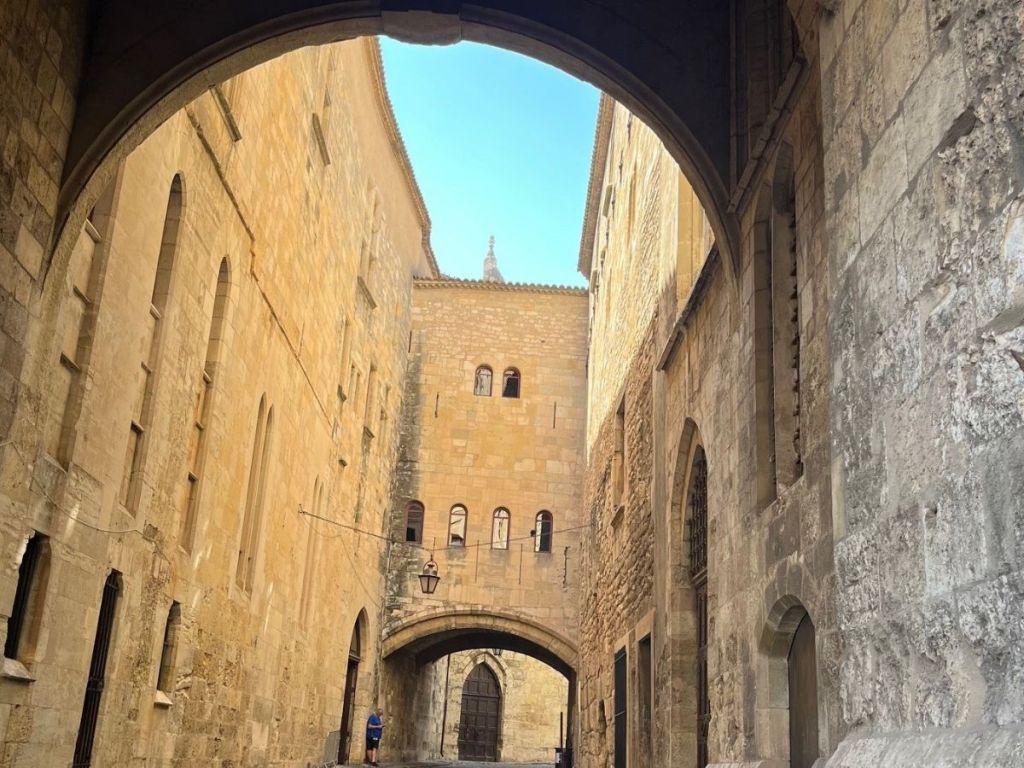
The vaulted Passage de l’Ancre of the Archbishops Palace in Narbonne ©Algoma
Narbonne, City of the Archbishops
By the end of the 9th century, Narbonne was the seat of a vast ecclesiastical province covering southern France—stretching from Uzès in the Gard department to Toulouse—and, following Charlemagne’s conquests, parts of what is now Spain.
Discover its story
Its archbishopric controlled up to twelve bishoprics, and Narbonne’s influence rivaled what it had once enjoyed in Roman times. The Archbishop’s Palace can be reached by taking the Passage de l’Ancre, located between the Old Palace and the New Palace of the Archbishops.
To the right, you will find Narbonne’s original Romanesque palace. Dating back to the 10th and 11th centuries, it is laid out around an inner courtyard: the Cour de la Madeleine. Alongside the 13th-century Madeleine Tower stands the Theodard Tower. Dating from the 9th century, it is the oldest tower in the palace complex. It once served as the bell tower for a Romanesque cathedral that no longer exists. You can recognize it by the curious crenellations along the roofline; far from being defensive features, these are the remnants of a structure that once supported an upper story—now destroyed.
To the left, the New Palace is also built around an inner courtyard—the Cour d’Honneur—which provides access to the museum housed in Narbonne’s Archbishop’s Palace. Here, too, the stonework bears the marks of the passing centuries. Construction began in the second half of the 13th century and continued—as we have seen—right up to the 19th century with Viollet-le-Duc’s Neo-Gothic façade; the rear of its pediment is visible from the inner courtyard. Also rising above the courtyard are the Keep commissioned by Archbishop Gilles Aycelin and, more discreetly, Saint-Martial Tower.
At the far end of the passage lies the entrance to Narbonne’s Saint-Just and Saint-Pasteur Gothic cathedral; construction began in 1272, and the choir was completed in 1332.
Together, these buildings form a prestigious architectural complex that reflects the immense power of the resident ecclesiastical authority—rivaling, in sheer scale, the monumental Papal Palace complex in Avignon.
That is saying something.
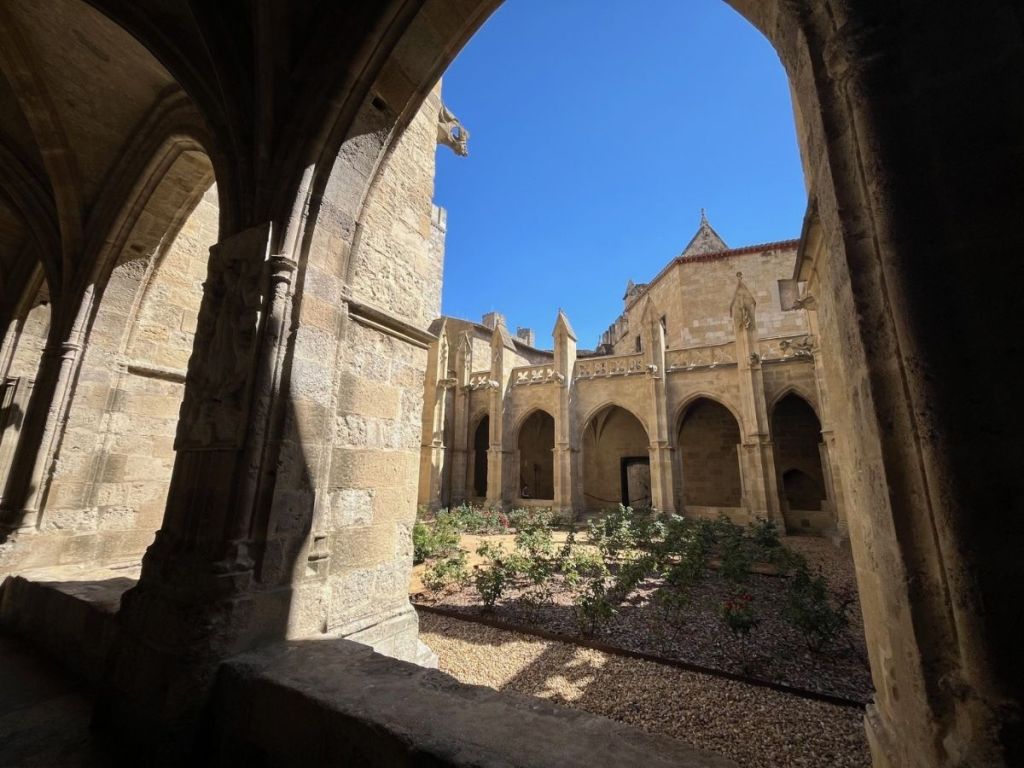
The 14th-century cloister of the Cathedral of Saints Just and Pastor in Narbonne ©Algoma
The Cloister
At the end of the Passage de l’Ancre, climbing a few steps will allow you to reach the cloister of Narbonne Cathedral.
Discover its story
Dating from the 14th century, the cloister was built on the site of the former Romanesque church—you can spot the Théodard Tower—and it links the Archbishop’s Palace with Narbonne Cathedral, the Cathedral of Saints Just and Pastor.
Initially the cathedral was meant to be huge. However, at that time, Narbonne was encircled by ramparts, much like Carcassonne. The original defensive wall dated back to the 3rd century and was designed to guard against barbarian invasions. It tightly enclosed the city—which was then confined to the left bank, north of the Aude River—leaving the amphitheater and the suburbs outside; it encompassed the Capitol (long since vanished) and what would eventually become the Archbishop’s Palace.
This wall became the central issue between the city consuls and the archbishops: to continue building the massive cathedral, the ramparts had to be demolished. This was the first half of the 14th century, a time of great unrest—most notably the Hundred Years’ War with England, which began in 1337. The consuls opposed the demolition of the ramparts. The failure of the Black Prince’s assault during his 1355 campaign vindicated their stance.
Fortunately, the cloister was completed. Today, its vaulted galleries provide a welcome refuge from the summer heat and recall a time when the clergy gathered here every day. Like cloisters everywhere, they invite you to slow down. To wander and gaze. Or even, like so many did before us, to meditate :).
Saint Sebastian: A Kid from Narbonne
Discover its story
Saint Sebastian is said to have been born in Narbonne before growing up in Milan, Italy. Let us linger a moment in this rich and significant Catholic tradition to better understand the cultural context of France.
He is certainly no ordinary figure among the Catholic saints. A martyr during the spread of Christianity in the 3rd century, he was condemned to be pierced by arrows—wounds from which he miraculously recovered—before ultimately being beaten to death with rods.
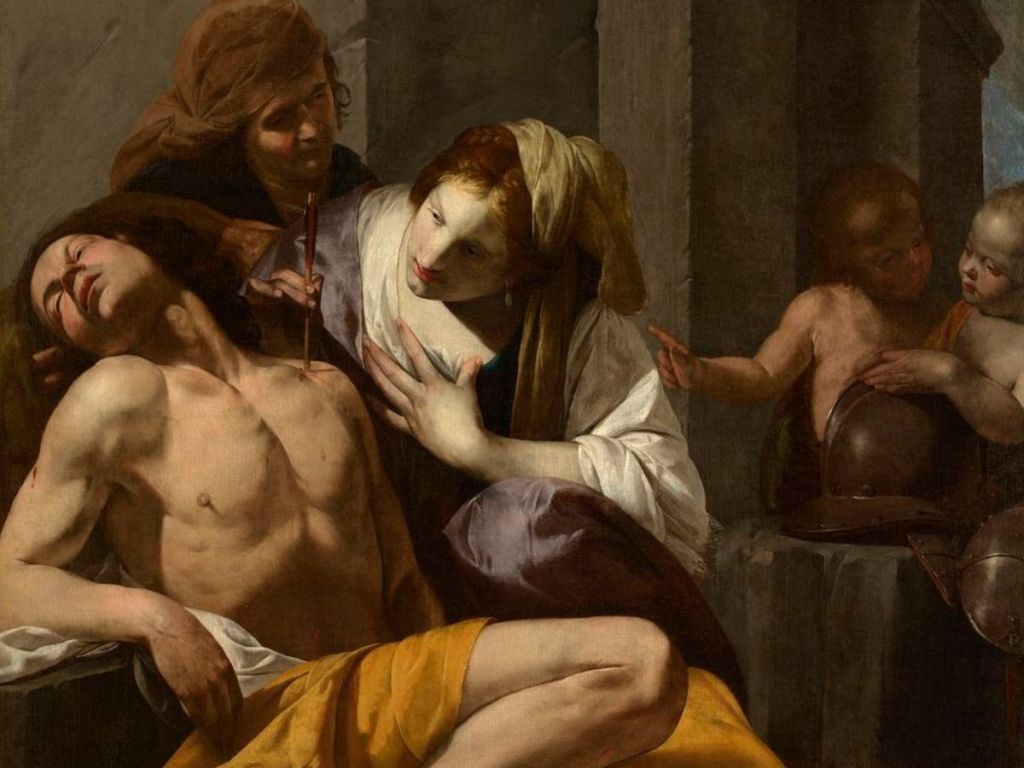
From that time on, Saint Sebastian became the object of a cult that was further amplified and transformed by artistic depictions, particularly those of the Renaissance. Images of the saint tied to a post—his body bristling with arrows or being tended to by Saint Irene—gradually inspired a current of thought that came to view the martyr as a gay icon.
It is worth noting that while early medieval depictions portrayed the saint as a bearded, middle-aged man, the Renaissance reimagined him as a beardless youth; the post to which he was bound allowed for languid, sensual, and even erotic poses.
The 20th century would ultimately establish him as an icon of gay culture. Having originally been revered as an intercessor with God during plagues and epidemics, the link to homosexuality was further reinforced with the emergence of the AIDS crisis.
In Narbonne, the Church of Saint Sebastian is believed to have been built near the site of his birth. Today, the church serves the most traditionalist Catholics; Mass is celebrated there in Latin according to the rite that predates Vatican II—a pivotal moment for the Catholic Church that sought, among other things, to make the liturgy more accessible to the faithful by allowing the use of vernacular languages alongside Latin.
If you are fortunate enough to visit the Church of Saint-Sébastien—as the church is rarely open—you will find a 17th-century painting of Saint Sebastian being tended by Saint Irene, executed in the Caravaggesque style and featuring dramatic chiaroscuro effects.
But for now, let us leave behind the darkness of wounded bodies and return to the sunlit streets of Narbonne.
Photo: Saint Sebastian Tended by Saint Irene, Antonio de Bellis, c. 1640 — Musée des Beaux-Arts de Lyon, CC BY-SA 4.0, via Wikimedia Commons. Different rendering of the scene depicted in the seventeenth-century painting housed in the Église Saint-Sébastien in Narbonne.
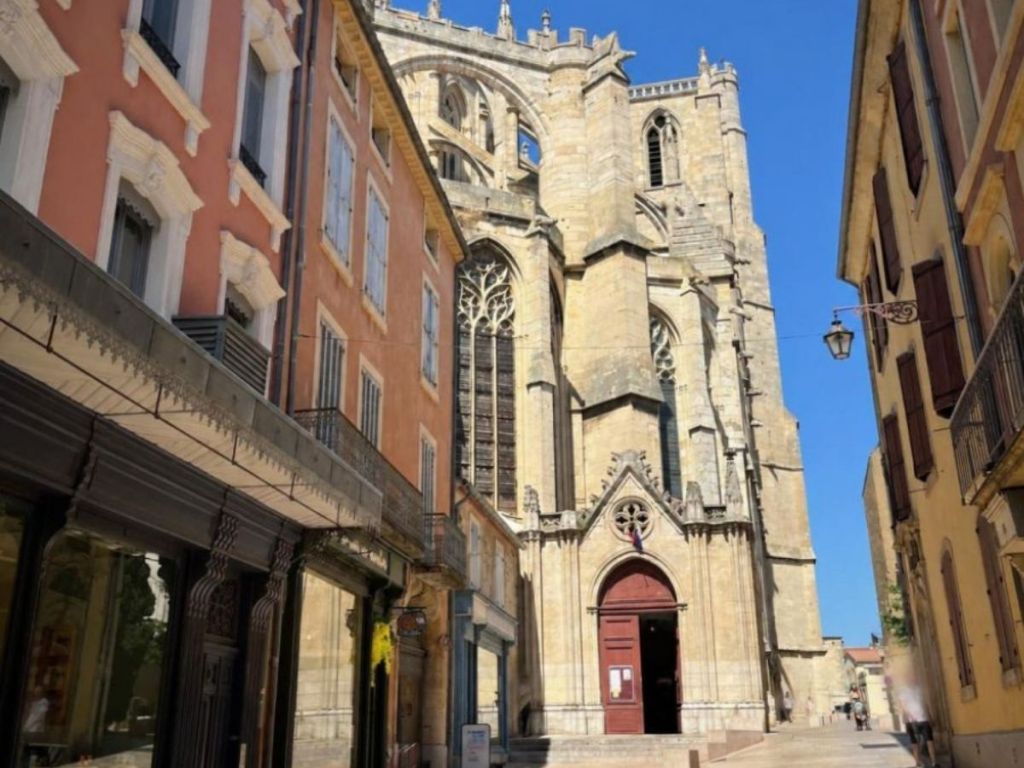
Gothic choir of the Cathedral of Saints Just and Pastor ©Algoma
The Beginning of a Colossal Project That Was Never Finished
Narbonne being one of the most important cities in medieval Europe, as the seat of an archbishop overseeing as many as twelve bishoprics, it obviously needed a cathedral worthy of its rank.
Discover its story
A French pope decided to have it built. Clement IV, born in Saint-Gilles (in today’s Gard department), had previously served as Archbishop of Narbonne. For those of you who aren’t Catholic, a quick explanation may help. Popes are elected by the College of Cardinals. Before entering the Church, some had led secular lives, and Clement IV was one of them.
A brilliant lawyer, he served as an adviser to King Saint Louis and later to Pope Urban IV. He had even been married and raised a family. After his wife’s death, he became a priest and eventually rose to the highest office in the Catholic Church. He was the one who decided that Narbonne deserved a new cathedral. From the very beginning, it was intended to stand alongside the greatest cathedrals in France. Although this monument was never completed, its beginning remains magnificent.
When you get here, everyone will tell you that the choir vaults—the only part of this magnificent monument that was ever completed—rise almost as high as those of the great Gothic cathedrals of northern France. Step inside and you won’t doubt it: the sheer height of the building will strike you. Slender and dynamic, the stained-glass windows—some of which are genuinely medieval (well… only a handful, to be fair)—cast a shimmering light into the chapels.
One chapel in particular will catch your eye: the central Chapel of Notre-Dame-de-Bethléem, home to a remarkable 14th-century polychrome stone altarpiece. Beautifully carved, it may have been intended to teach the faithful through images, fulfilling a role that was normally entrusted to the sculpted cathedral portals. Alas, this temporary solution was not supposed to last so long.
You can’t miss the 17th-century high altar or the 18th-century choir stalls—in fact, you’ll almost bump into them as you walk through the church. A quick look at the magnificent organ… and… that’s it! A curious passage through what still feels like a construction site lets you admire the choir from behind the stalls and, after that… well, that’s where the cathedral simply stops.
All because of a decision made back in the 14th century. Isn’t that extraordinary?
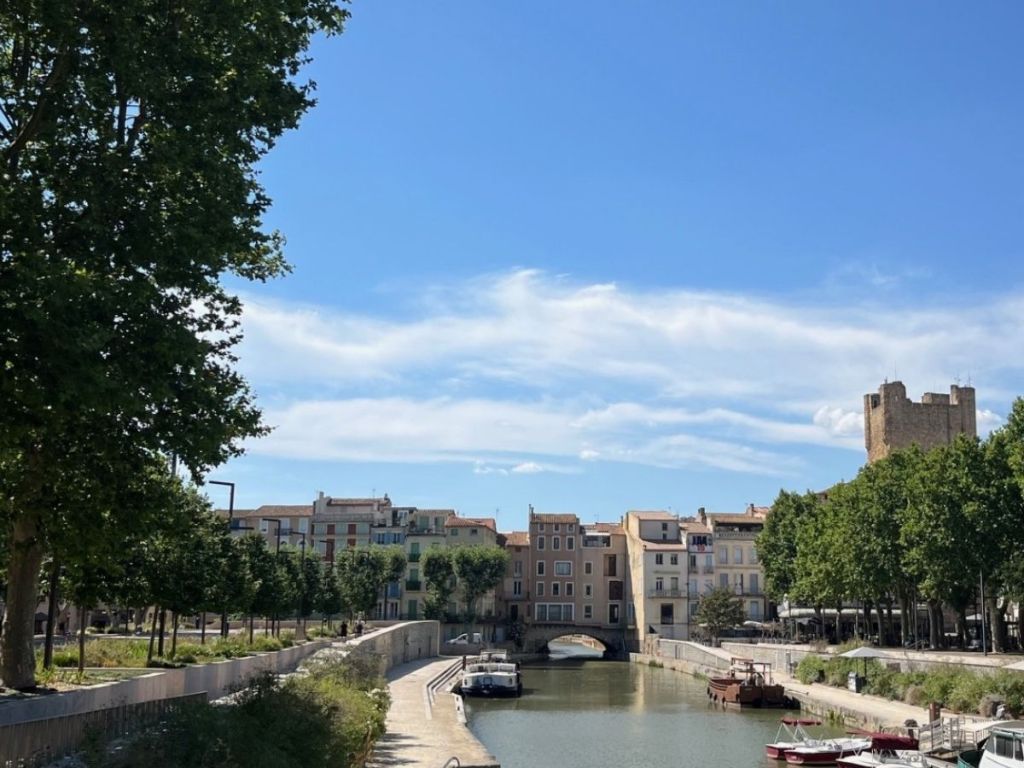
The Robine Canal with the inhabited Pont des Marchands ©Algoma
The Robine Canal: A Touch of Florence in Narbonne
Narbonne is one of the few cities in France to boast an inhabited bridge—much like (let’s not shy away from comparisons!) the Rialto in Venice or the Ponte Vecchio in Florence.
Discover its story
This bridge dates back to antiquity, just like Florence’s earliest bridge; it allowed travelers to continue along the Via Domitia and cross the Aude River. At the time, the bridge had seven arches.
You have to picture the Aude flowing alongside Narbonne during the Roman era. Today, the river empties into the Mediterranean Sea northeast of the city, near the border with the Hérault department, but its course has shifted over the centuries, shaped by a variety of factors, including major floods.
The river’s former bed became a remnant channel that locals continued to cross and began to make greater use of. They built houses on the bridge in the Middle Ages and modified the waterway to power mills in the 14th century. Later still, in the 18th century, the waterway was canalized, extending the great project initiated by Riquet to link the Mediterranean Sea to the Atlantic Ocean via the Canal du Midi.
To ensure you don’t miss this remarkable inhabited bridge, do not simply continue along Rue Droite—which turns into the Pont des Marchands—when leaving the Place de l’Hôtel de Ville; if you do, you won’t even realize you are crossing a bridge: it looks like just another street, and nothing suggests that it is actually… a bridge!
And yet, it is a bridge.
So, instead, you should turn left and that is very tempting, because the open expanse of the Cours de la République—running alongside the canal with its triple row of plane trees—invites you to head that way in search of a little coolness. After walking a few steps, turn around! The bridge’s sole visible arch stands out elegantly beneath the houses and shops that span the canal.
With so many cafés around, this might even be the perfect moment to sit out on a terrace, enjoy an ice cream or a drink, and simply savor the moment.
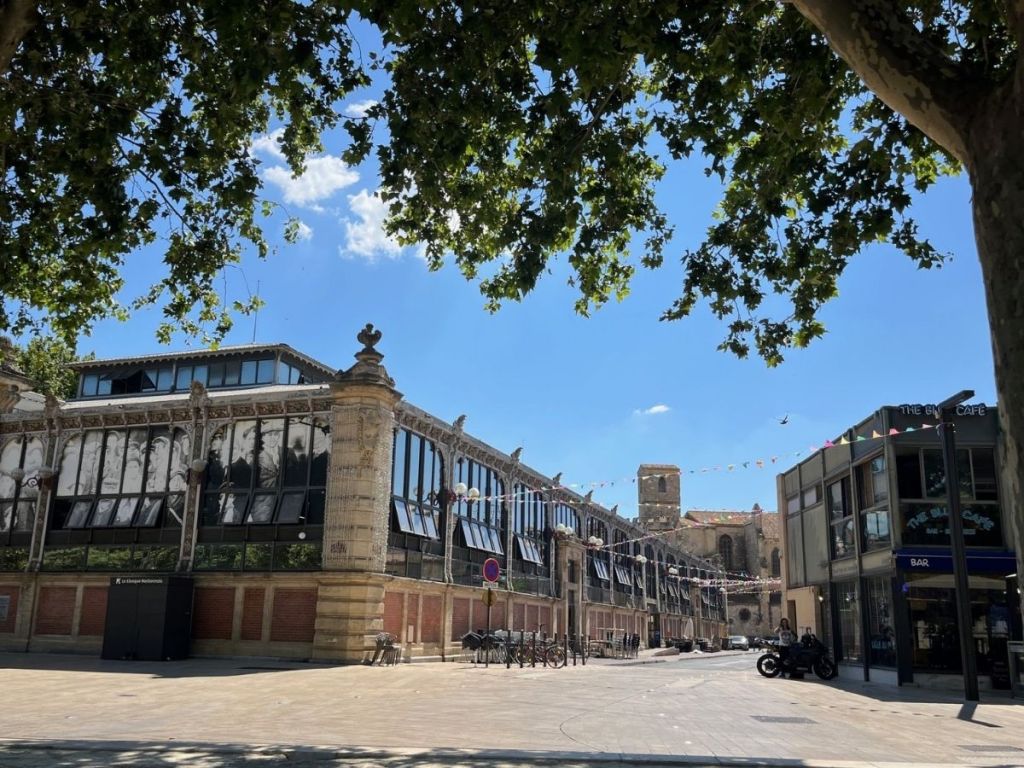
Les Halles, Narbonne’s iron-and-glass market hall ©Algoma
Narbonne: Another Two-Headed City
We saw that Carcassonne was a dual-centered city; well, so is Narbonne!
Discover its story
The Roman city we just explored lies on the left bank, while a new district—still known today as Le Bourg (“the borough” in French)—developed during the Middle Ages on the opposite bank of what is now the Robine Canal.
Right bank? Left bank? Just like in Paris? Let’s take a brief detour. In the United States, you orient yourself using cardinal directions. In France, rivers serve as the reference point: the direction of the river’s flow determines which side is the right bank and which is the left.
Actually, your approach is far more rational; after all, how can you tell which way a river flows when you’re lost in the maze of streets of an unfamiliar city in a foreign land…? Even for us French, it can be difficult to get our bearings, and it would certainly be simpler to speak in terms of north or south (though perhaps less poetic…? That remains an open question ;)).
So, in Narbonne, the city—originally enclosed within 3rd-century AD ramparts—needed to expand. From the 5th century onwards, it grew on the other side of the Aude River (before the river changed course, leaving what is today the Robine Canal as a secondary channel).
Just as in Carcassonne, this new district became the hub of the city’s craft and trade activity. In Narbonne’s Bourg, as in Carcassonne’s Bastide, the cloth trade drove the city’s prosperity; in both cities, the Aude River played a crucial role in processing cloth and transporting the goods. Thus, over the centuries, this Narbonne neighbourhood saw the rise of shops, artisan workshops, churches, squares, and fountains, followed later by working-class houses and bourgeois residences—a number of which still bring the streets to life today with their facades.
You will also want to cross the Canal de la Robine if only to visit the famous Narbonne market hall, Les Halles.
And famous it certainly is. Built of iron and glass, inaugurated in the early 1900s, it is a prime example of late 19th- and early 20th-century architecture, in the style of the Baltard market halls, a style already admired in Béziers. Above all, once inside, you will love the feast of colors, aromas, and flavors awaiting you.
Whether for the churches (including the frog adorning the holy water stoup at the Church of Saint Paul), the facades (particularly that of the Maison des Inquants , where cloth was once traded), the street paving (featuring the distinctive pink marble of Caunes-Minervois), or simply the pleasure of lunching amidst the festive atmosphere of Les Halles, you will be glad you crossed to the right bank.
What’s more, Le Bourg district holds another surprise in store: a chance to discover the interior of the home where Charles Trenet—a legend of French popular music—was born.
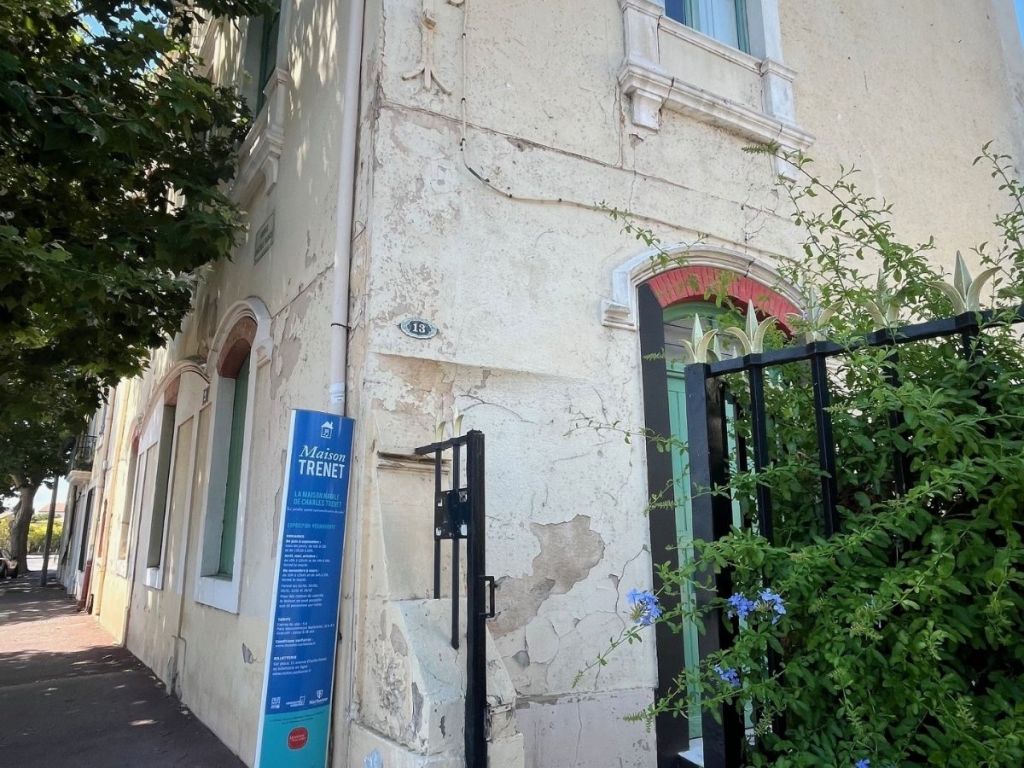
Charles Trenet’s birthplace in Narbonne ©Algoma
Charles Trenet: The Man Behind “Beyond the Sea”
Here we are, in front of Charles Trenet’s birthplace. Born in Narbonne in 1913 and died in 2001, this singer spanned almost the entire 20th century and holds a truly unique place in French popular music.
Discover its story
Surprisingly, you very likely know at least one of his songs: “Beyond the Sea”. He wrote the original French song, La Mer, while on a train from Sète to Montpellier. It must be said that the scenery is truly inspiring! Even today, the journey—with Sète and the Mediterranean Sea on one side and Étang de Thau lagoon on the other—is a magical experience not to be missed when visiting the Hérault region.
It is also worth noting that this French song is entirely dedicated to the sea; unlike the version you know, it is not a love song about two people separated by the ocean, but an ode to the Mediterranean:
La mer / Qu’on voit danser le long des golfes clairs / A des reflets d’argent
The sea / That dances along the clear bays / Has silver reflections
Charles Trenet—quickly nicknamed “Le Fou chantant” (The Singing Madman)—was an extraordinarily prolific singer-songwriter. Known for his wit and lyrics that sometimes bordered on surrealism, he was a musician who helped introduce jazz and swing to French popular music. His songs have been covered by everyone from rock bands to rap artists, and he boasts an impressive discography.
It includes charming hits that appeal to anyone who loves France: Nationale 7 celebrates the famous national highway that long served as the holiday route for Parisians heading south, while Douce France—written in 1943—evokes France before the German Occupation.
Other songs, such as Y’a d’la joie or Boum!, (when your heart goes boom!), celebrate a cheerfulness and good humor not always experienced by the man himself—who was very discreet about his homosexuality and was at one point accused of offenses involving minors. With tracks like Que reste-t-il de nos amours ? (I Wish You Love) or Vous qui passez sans me voir—a song made famous in the United States by Jean Sablon in the mid-20th century—Trenet’s melodies won over not only America but the rest of the world.
Above all, when you’re in Narbonne, you must visit the house where he was born—now the Charles Trenet Museum. Restored and preserved as it was during the singer’s lifetime—a place of inspiration and renewal—it offers a fascinating glimpse into the interior of a 20th-century French home.
Interested in visiting Narbonne?
→ Find a selection of guided tours and activities
If you book through this link, I may receive a small commission at no extra cost to you.
Want to explore further?
Discover the spectacular medieval world of Carcassonne, the Iconic Citadel…
For sea, sunbathing, and seaside villages, head to the Narbonne Coast…
And if you’re after strong emotions, discover the castles, abbeys, and landscapes of the Inland Aude…
And just beyond, two neighboring lands await: one where the Mediterranean meets la joie de vivre — discover the Hérault… and another, a step further, where Rome, wild landscapes and the sea meet — explore the Gard…
 Algoma