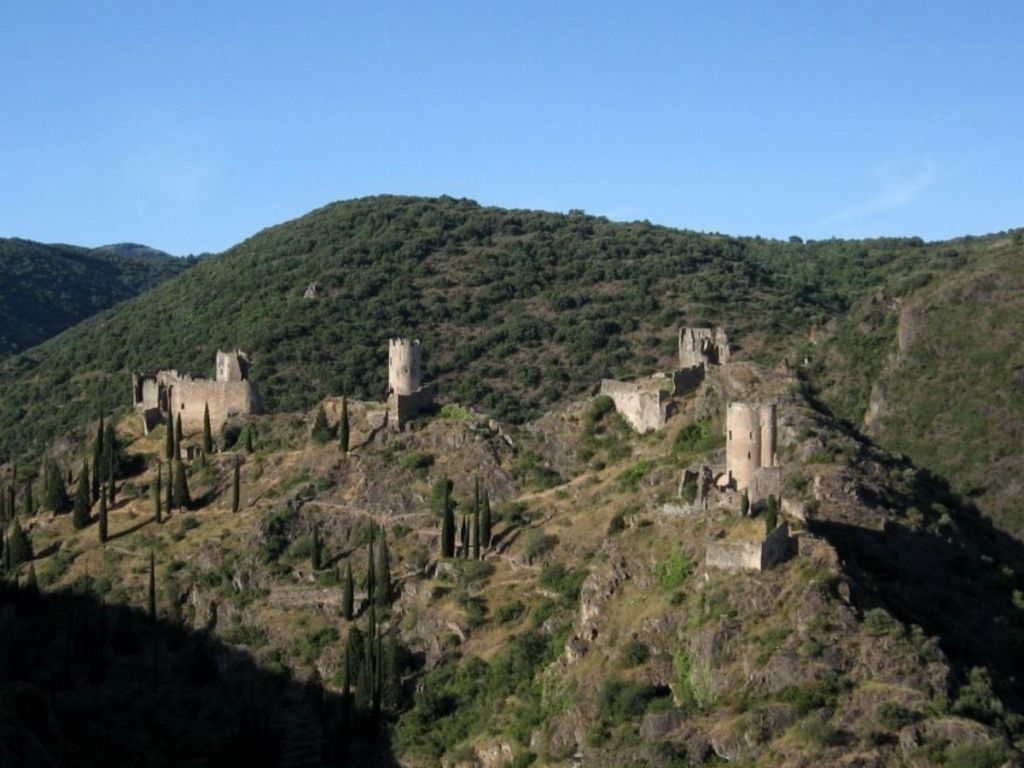
We are in the Aude, one of France’s most beautiful departments. Venture inland and you will find amazing fortresses perched on rocky peaks, magnificent abbeys rising among the Corbières, and limestone hills scented with garrigue, olive trees and pine forests.
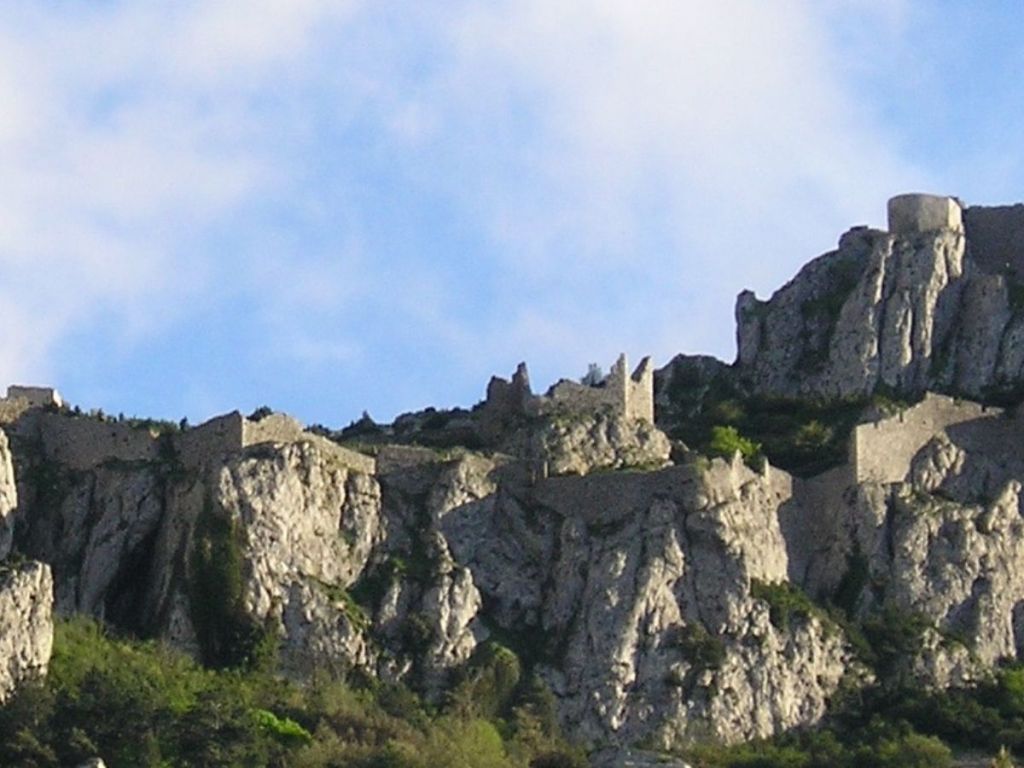
Peyrepertuse, the longest of the royal fortresses Source Wikimedia Commons
Once upon a time, the Cathar castles…
Discover its story
Here we are, at the foot of the royal fortresses of Languedoc, some of them just recently inscribed on the UNESCO World Heritage List in July 2026.
The ones the French still commonly call Cathar castles—although they are not, strictly speaking, Cathar castles.
The ones that stand proudly atop rocky peaks, defying time and comprehension: how could men have built such fortifications at such altitudes?
The ones telling us the story of a turbulent period in the history of southern France: the rise of Catharism, the Albigensian Crusade, and the gradual extension of royal power.
The ones standing on a strategic frontier at a time when the Kingdom of Aragon—present-day Spain—lay to the south.
Today, let us admire the splendid silhouette of these true architectural marvels and discover their fascinating history.
Lastours Castles Source : Wikimedia Commons
Cathar Castles and Royal Fortresses
The French tend to call them “Cathar castles”—but what exactly does that mean? To understand this name, we first need to go back to Catharism.
Discover its story
Catharism, a Christian religious movement that developed between the 11th and 13th centuries, became particularly influential in Languedoc. Cathars sought refuge in fortified settlements known as castrums, where sympathetic local lords could offer them protection. These castrums are at the heart of the story behind the expression “Cathar castles.”
The Cathars did not build the castles we see today. Rather, they sometimes found refuge in medieval fortified settlements that already existed. Some of these sites were later destroyed or transformed by royal authority, while others were rebuilt or replaced by royal fortresses. Initially, Catharism advocated a return to the roots of Christianity and challenged the abuses and moral laxity within the Catholic Church at the time. To counter a movement that was steadily gaining ground, papal authorities launched a harsh crackdown starting in the 13th century.
In 1209, Pope Innocent III called for the Albigensian Crusade—the first crusade fought within Christendom. After two decades of warfare, the Cathar faith had not been entirely eradicated, and the papacy established the Inquisition, which soon operated in places such as Carcassonne.
Cathars who refused to renounce their faith were persecuted and faced execution. One of the final and most tragic episodes of the repression took place in 1244 at Montségur, in present-day Ariège, where around 220 Cathars were burned at the stake.
So the term “Cathar castles” evokes the places where Cathars lived, sought protection or were pursued during one of the most turbulent periods in the history of medieval southern France.
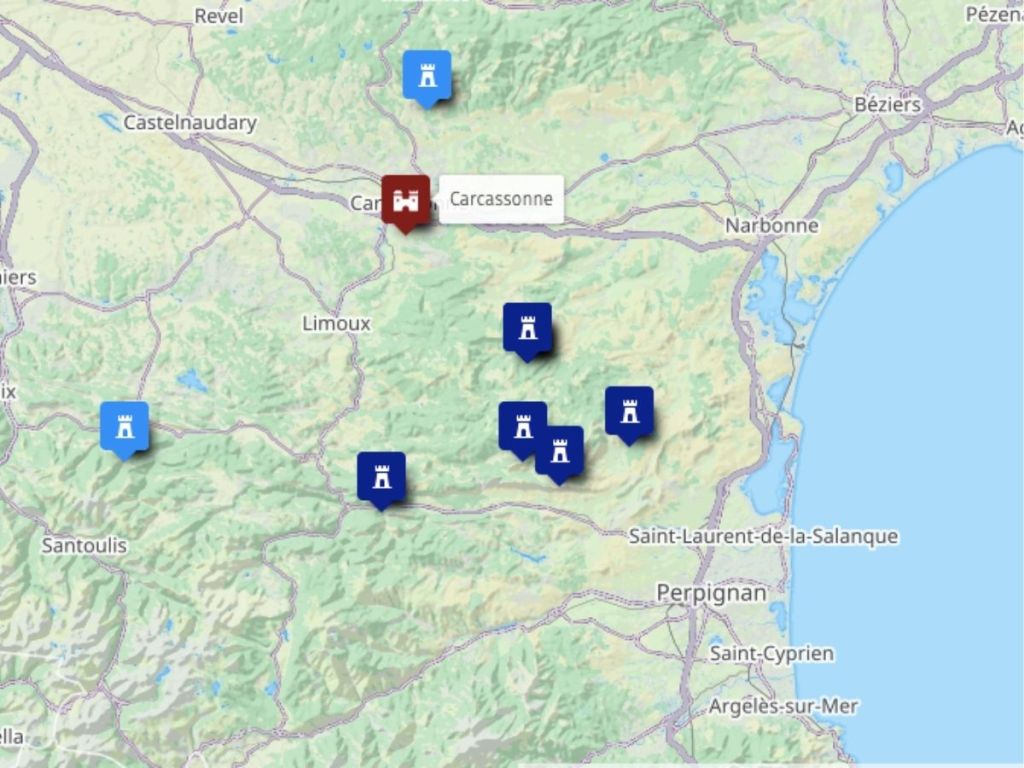
Royal Fortresses of Languedoc — 8 sites inscribed on the UNESCO World Heritage List.
The Royal Fortresses—and Beyond The royal fortresses inscribed on the UNESCO World Heritage List are striking. Perched on ridges and rocky peaks, they seem almost to grow out of the bedrock itself. And, naturally, they have to be earned.
Discover its story
The eight UNESCO sites inscribed in 2026 are not the whole story. The Aude and the neighboring Ariège are dotted with medieval fortresses, castles and fortified settlements that bear witness to the same turbulent period.
The UNESCO sites—Carcassonne, Aguilar, Lastours, Montségur, Peyrepertuse, Puilaurens, Quéribus and Termes—represent a core part of the defensive system established by the Capetian monarchy in the 13th and 14th centuries, following the Albigensian Crusade. Their strategic positions were no accident. Built on ridges and rocky peaks, they commanded sweeping views of the surrounding territory and helped protect the southern frontier of the Kingdom of France.
This is why the expression “royal fortresses” is more historically accurate than the romantic term “Cathar castles.” Yet the distinction is not always straightforward. Some royal fortresses were built on or near earlier sites associated with the Cathars, while others were constructed specifically as royal strongholds. And beyond the eight UNESCO sites, numerous other castles and fortified places preserve different chapters of this same medieval story.
Each fortress has its own character, and together they occupy a remarkable range of heights, from Aguilar and the Lastours castles, at around 320 meters, to Montségur in Ariège, perched at nearly 1,200 meters.
This is precisely what gives them their unrivaled charm today: visible from afar, they appear as a challenging goal that seems to taunt the traveler. The paths leading up to them—varying in steepness—wind through Mediterranean vegetation before skirting defensive walls where one can easily imagine how vulnerable an attacker would have been. Yet, once inside the stronghold, the panoramic view is breathtaking.
From Aguilar, one can see as far as the Canigou massif in the Pyrenees; from Peyrepertuse—the longest of the fortresses, stretching 300 meters—the view extends to the Mediterranean. Together, they offer an incredible diversity of landscapes, alternating between valleys and mountainous terrain, limestone cliffs and pastures, low-growing garrigue scrubland and Mediterranean forests of holm oaks and pines.
Inside the fortresses, the passage of time—or sometimes royal orders, as in the case of the Château de Termes—has destroyed the structures. You step into spaces that are essentially empty, where only restoration work can bring the collapsed walls back to life. You can pass through vaulted gateways and descend stone steps worn smooth by centuries of use; occasionally, you might glimpse Gothic chambers within the keeps, such as at Quéribus.
Ultimately, the experience now lies in the realm of personal imagination, set against the magnificent backdrop of the Corbières massif.
Map: the 5 fortresses in deep blue are known as “the five sons of Carcassonne.” © Algoma – Discover France. Map data © OpenStreetMap contributors, tiles © Thunderforest.
Interested in a private day trip to the Lastours castles and vineyards from Carcassonne?;
→ Find a selection of guided tours and activities
If you book through this link, I may receive a small commission at no extra cost to you.
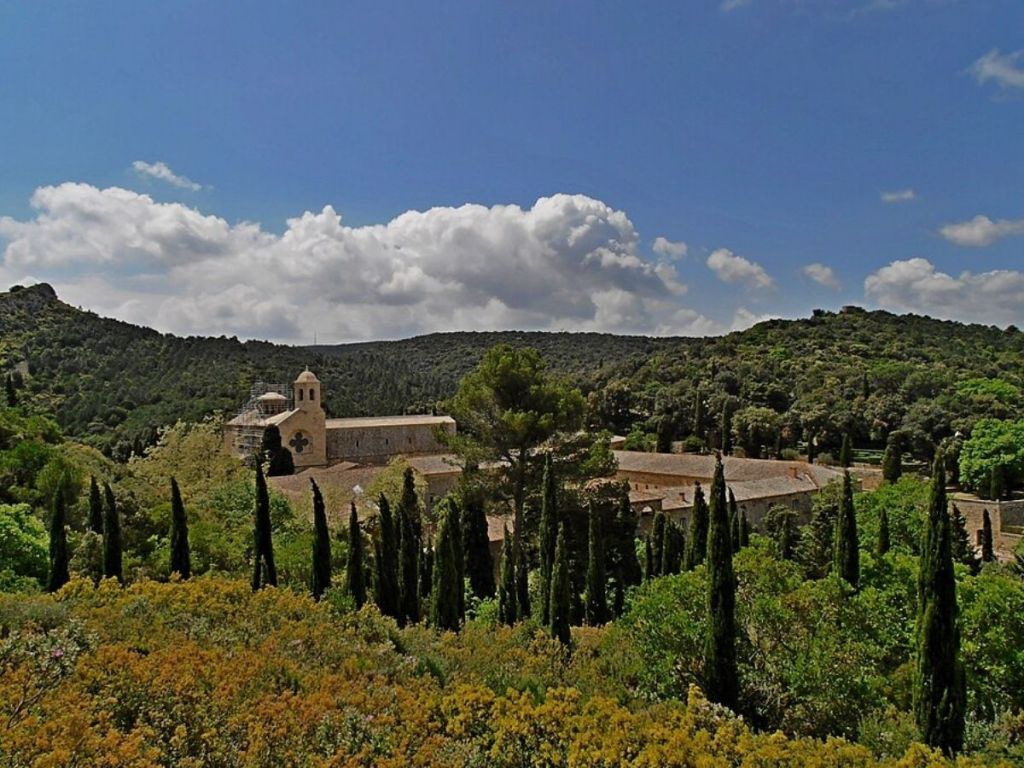
Fontfroide Abbey from afar. Source: Tournasol7, CC0, via Wikimedia Commons
Fontfroide Abbey: Spiritual and Material Opulence
Fontfroide Abbey, near Narbonne, owes its salvation to Gustave Fayet, an art enthusiast both artist and patron, in the early 20th century. In doing so, Fayet found himself contending with one of your compatriots—the very man who purchased the capitals from Saint-Guilhem-le-Désert that are now housed at The Cloisters in New York.
Discover its story
Fontfroide Abbey is certainly worth a visit, if only for its magnificent setting. The landscape of the Aude region is characterized by the contrasting terrain of the limestone hills of the Corbières massif. Covered in the region’s characteristic vegetation—garrigue, olive trees, and pine forests that delight the senses with their fragrance—these hills stretch as far as the eye can see around the cold spring (Fons Frigidus) that prompted the establishment of the first Benedictine monastery here in the late 11th century.
The abbey complex grew up around the church—built in the 12th and 13th centuries—with structures designed to house more than 300 monks and religious members of the community. Gothic-style side chapels were added in the 14th century. With its Romanesque nave, its 12th-century vaulted passageway (a narrow corridor that allowed religious members that were not monks to access the church in accordance with monastic rules), its chapter house, and its monastic buildings, the medieval Fontfroide Abbey is a spectacular sight.
The site’s spiritual importance in the region was evident as early as the repression of Catharism, earning it a reputation as a bastion of orthodoxy. Indeed, the papal legate assassinated at Saint-Gilles in 1208 had come from Fontfroide Abbey. The following century, Pope Benedict XII—elected in 1334—had been abbot of Fontfroide.
However, this period of intense spiritual life was followed by a long era during which the abbey ceased to be an active place of prayer, becoming instead primarily a source of income for abbots—appointed first by the Pope and later by the King—who held the title in name only. As the abbey’s website points out, this was also a period of considerable architectural expansion.
Indeed, several families succeeded one another over the generations, carrying out various improvements—such as the creation of the Italian-style gardens in the 16th century (attributed to Constance de Frégose, who was herself of Italian origin) and the construction or modification of buildings to better accommodate their occupants during the 17th and 18th centuries. The Entrance Courtyard and the Cour d’Honneur (Main Courtyard) date from this period.
The French Revolution brought an end to this era of opulence. Although the 19th century saw an attempt to restore monastic life, the monks were permanently expelled in the early 20th century. The Abbey of Fontfroide was subsequently acquired by Gustave Fayet and his wife Madeleine; their descendants remain actively committed to keeping the site alive and ensuring that its legacy continues to flourish.
It is this remarkably well-preserved and beautiful place that you can visit.
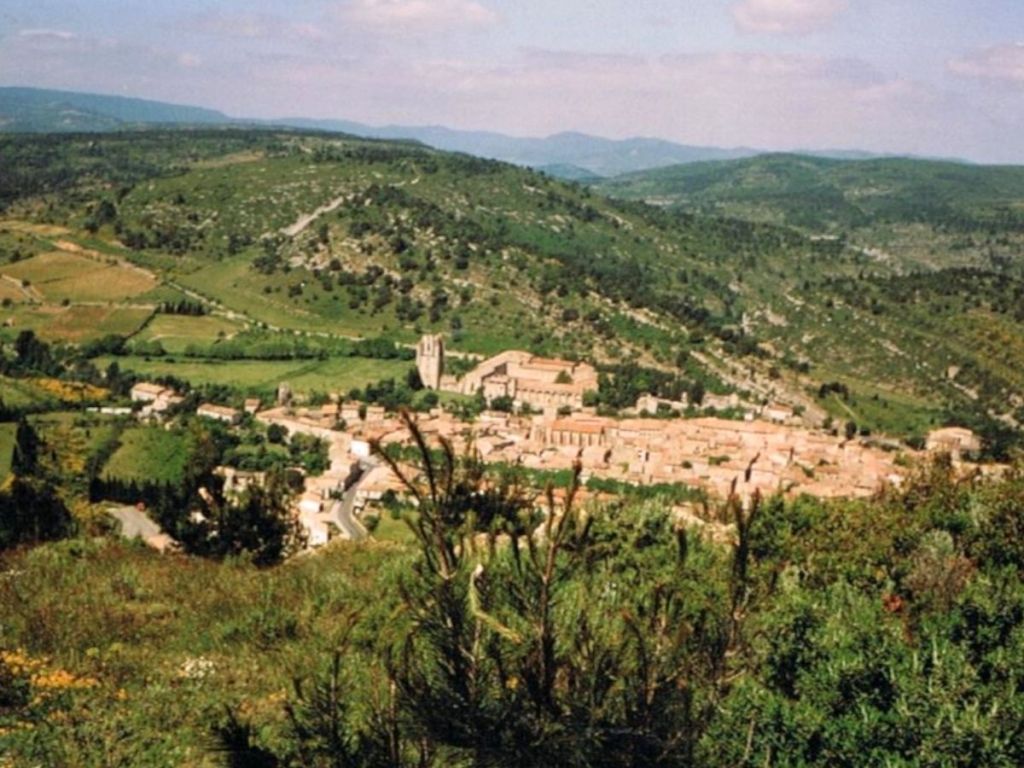
Lagrasse abbaye and village. Source: Edelmauswaldgeist, CC0, via Wikimedia Commons
Like a Bridge over a Calm River—Linking the Village and the Abbey at Lagrasse
Another extraordinary abbey awaits us in the Aude region: Lagrasse. Unlike Fontfroide Abbey, nestled in its lush green setting, this one is not isolated; it sits right next to one of those charming French villages that officially bear the “Most Beautiful Villages of France” label.
Discover its story
The approach by road is a marvel in itself: the journey through the Corbières—with its limestone terrain and slopes blanketed in vineyards and olive groves—is truly enchanting. Then, suddenly, around a bend in the road, the abbey’s bell tower comes into view. Rising above the village and overlooking the Orbieu River, its golden stone creates a soft, harmonious silhouette against the landscape.
The abbey we are heading toward bears the marks of centuries past. Indeed, this is one of its defining features: the abbey presents a rare architectural blend, juxtaposing medieval sections with Classical additions from the 18th century. Romanesque transept vaults sit alongside the Gothic nave; the unfinished bell tower dominating the valley dates from the 16th century; the quarters built for wealthy abbots evolved into veritable palaces; and a Cour d’honneur, or formal courtyard, was constructed in the 18th century, coinciding with the design of the cloister—completed in 1760—that visitors explore today.
It is, therefore, a monumental complex that flourished from its founding in the late 8th century, eventually becoming a powerful abbey overseeing a network of around a hundred churches, priories, and monasteries and owning a vast territory extending as far as Toulouse and beyond the Pyrenees.
It is worth noting that, in the 12th century, the abbey was led by a particularly influential figure: Abbot Béranger de Narbonne. Connected to noble families in both Narbonne and Barcelona, he would go on to become the Archbishop of Narbonne himself—a position of no small importance, as we have already seen (more in Narbonne, City of the Archbishops).
The abbey later went through a darker period, largely due to competition from the Cistercian and Templar orders. Interestingly, the nearby Fontfroide Abbey was Cistercian, so the rivalry came from a close neighbor, making it all the more formidable. The Cathar movement and the Hundred Years’ War also played a role in this less prosperous era. The village was forced to fortify itself, and the abbey had to add defensive features. The abbey subsequently enjoyed further periods of prosperity before the French Revolution in the 18th century put an end to the site’s religious vocation—at least until 2004.
The complex open to visitors today is split in two: one part belongs to a religious community, while the other is owned by the Aude department. However, with a little planning, you can visit both sites on the same day while still finding time to stroll through the picturesque streets of the village on the other side of the river.
Interested in a day trip combining Lagrasse and the Abbey of Fontfroide?
→ Find a selection of guided tours and activities
If you book through this link, I may receive a small commission at no extra cost to you.
Want to explore further?
Discover the spectacular medieval world of Carcassonne, the Iconic Citadel…
Explore Narbonne, where Roman, medieval, and Mediterranean history meet…
For sea, sunbathing, and seaside villages, head to the Narbonne Coast…
And just beyond, two neighboring lands await: one where the Mediterranean meets la joie de vivre — discover the Hérault… and another, a step further, where Rome, wild landscapes and the sea meet — explore the Gard…
 Algoma