Venture inland and the Hérault reveals a world of unexpected depth — ancient cities, a UNESCO-listed canal, a medieval abbey tucked into a limestone gorge, and turquoise river waters that invite you to linger.
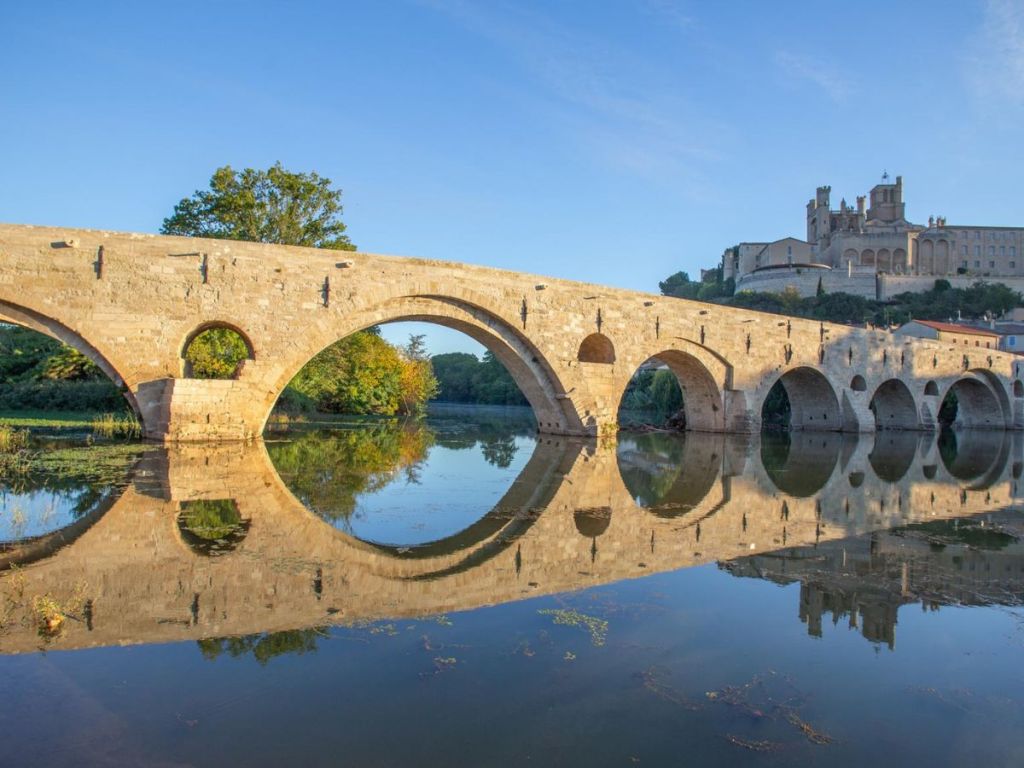
The Pont Vieux and Saint-Nazaire Cathedral, mirrored in the Orb © Office de tourisme Béziers Méditerranée – Pont vieux @Karinegregoire
«Dieu reconnaitra les siens».
Béziers, proudly perched upon its hill, is one of the oldest cities in France—possibly even older than Marseille.
Discover its story
What immediately strikes the visitor when approaching the city is its cathedral, rising like a fortress and overlooking the Orb River from a promontory that offers a commanding view of the surrounding landscape.
Evidence of very early settlements can be found near Béziers. The oppidum of Ensérune, located about ten kilometers from Béziers, bears witness to the presence of protohistoric peoples and Greek influence attested there as early as 660 BC. The Roman era solidified the importance of the city. Yet, after Roman rule, Béziers endured several centuries of domination by the Visigoths and then the Saracens and it was primarily during the Middle Ages that the city acquired its current appearance.
In fact, the Saint-Nazaire Cathedral was built on the site of an earlier Romanesque cathedral, itself built upon the remains of a Roman temple. Rebuilt between the 13th and 15th centuries—after the dramatic sack of Béziers during the Albigensian Crusade, when the city was brought back under the authority of the French monarchy allied with the Church—it stands as a characteristic example of Southern Gothic architecture, with its single nave and distinctly defensive exterior.
If you are feeling brave, do not hesitate to climb the 165 steps of the bell tower to enjoy the 360° view over the city and the Languedoc plain, stretching as far as the Montagne Noire and the Pyrenees.
It is in Béziers that one can find the Church of the Madeleine about which a Pope’s representative is said to have uttered the terrible phrase still familiar to many French people today: “God will recognize his own.”
The story is the following: during the sack of the city in 1209, at the beginning of the Albigensian Crusade against the Cathars, some inhabitants of Béziers—Catholics and Cathars alike—had taken refuge in the Church of the Madeleine. When asked how to differentiate those to save, the papal legate Arnaud Amalric is said to have uttered the terrible phrase that still resonates today:
“Kill them all; God will recognize his own.”
Which in French runs: “Tuez-les tous, Dieu reconnaîtra les siens.” And thus Catholics and Cathars alike were killed indiscriminately.
Yet Béziers is not defined solely by these dramatic events. The medieval character of Béziers, shaped by the strong presence of the cathedral, the historic center, and the Vieux Pont (Old Bridge)—which you may already have crossed when entering the city—has been enriched over the centuries.
Among the most delightful traces of the past, the Jardin des Évêques (Bishops’ Garden) lies next to the cathedral. Dating from the late 17th century and laid out in terraces, this French-style garden, with its geometric paths and sweeping views over the Orb Valley below, is especially enchanting in the evening, when the sun sets over the horizon in the bluish mists of the distant landscape.
The 19th century also left a strong mark on the city with the construction of numerous buildings along streets and boulevards inspired by Haussmannian architecture. The Allées Paul Riquet, originally laid out at the end of the 18th century, were redesigned between 1840 and 1860, giving them their current appearance. Still a popular meeting place for locals today, this vast esplanade is a perfect spot for a stroll and a drink in the shade of century-old plane trees.
Among the most striking examples of this period, you shouldn’t miss the Béziers market halls, a fine example of late 19th-century iron-and-glass architecture reminiscent of the Baltard pavilions in Paris.
A walk through Béziers offers the pleasure of experiencing a rich variety of architectural styles and historical periods, each with its own distinct character.
Interested in visiting Béziers?
→ Find a selection of guided tours and activities
If you book through this link, I may receive a small commission at no extra cost to you.
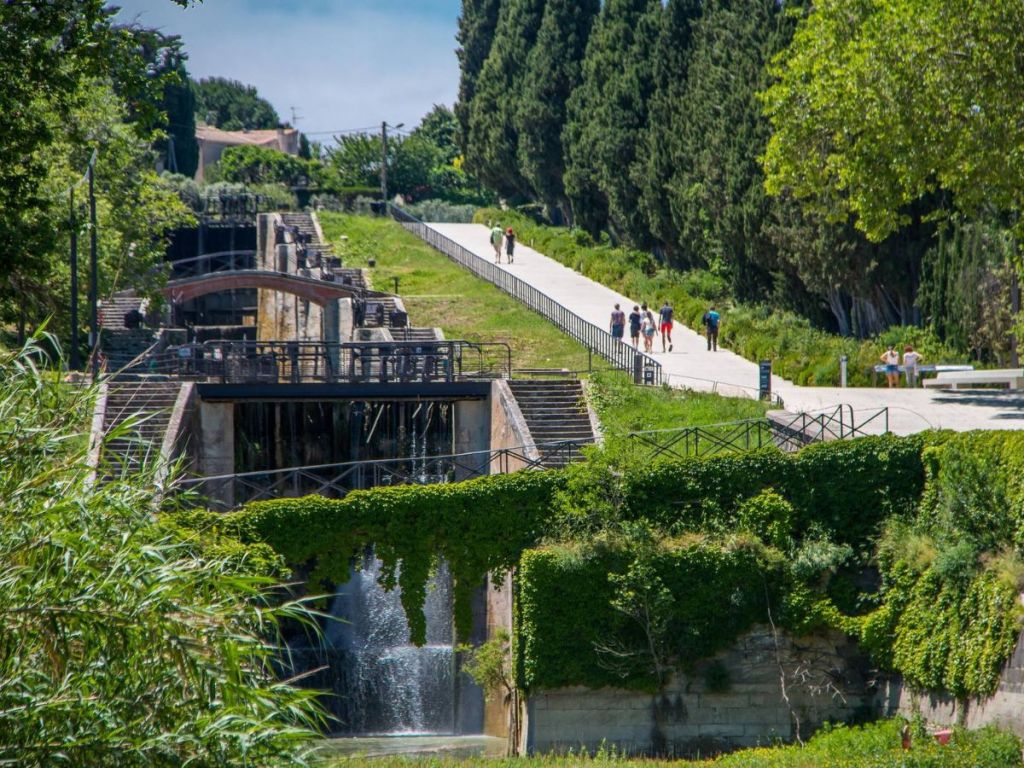
The Nine Locks of Fonséranes: Riquet’s staircase to the sea © Office de tourisme Béziers Méditerranée @Karinegregoire
The Canal du Midi and the Nine Locks of Fonséranes –
one of the most astonishing engineering works inherited from the past.
Discover its story
Built in the 17th century, the Canal du Midi and the Nine Locks of Fonséranes bear witness to the ingenuity and perseverance humankind is capable of. This extraordinary engineering work is part of a project of titanic proportions: linking the Mediterranean Sea to the Atlantic Ocean.
To grasp the importance of this project for navigation and trade, one only needs to look at a map of Europe. Instead of sailing around Spain through the Strait of Gibraltar -which we know, unfortunately, can become a major weakness in times of war-, the creation of this passage through France offered significant time savings– and considerable economic advantages!
The lock system, which allows boats to navigate changes in elevation, was already well-known at that time and was the subject of intense theoretical and practical studies, particularly in the 16th and 17th centuries, as demonstrated by Leonardo da Vinci’s interest in the subject. Yet one major challenge remained: the highest point of the route required a constant supply of water. Only one determined man, Pierre-Paul Riquet, born in Béziers and therefore from the region, managed to solve the problem by drawing water from the summit of the Montagne Noire and creating reservoirs.
One might think that this colossal undertaking was due to the will of the Sun King, yet Louis XIV was rather difficult to convince, and Riquet poured his fortune into the project, which only truly began to operate after his death.
The Canal du Midi, which links Toulouse to Sète on the Mediterranean coast, later became part of the larger Canal des Deux Mers connecting the Mediterranean Sea to the Atlantic Ocean.
Less than 3 kilometers from the center of Béziers, one can admire the Nine Locks of Fonséranes which is the solution found to solve one of the major challenges of the project: a difference in elevation of more than 20 meters had to be overcome between the canal and the Orb River. Pierre-Paul Riquet tackled this challenge and came up with the idea of creating a staircase-like succession of locks.
After testing a prototype of this lock system in Castelnaudary (a town about 100 kilometers from Béziers), and solving issues related to ground pressure at each “level” by creating oval-shaped basins, Riquet built this impressive 315-meter-long section of the canal, which includes 9 locks and 8 basins – creating one of the most spectacular sections of the Canal du Midi.
With the arrival of the railway, the canal gradually lost its commercial role and became primarily a waterway for tourism and pleasure boating. Today, it offers a unique way to discover southern France over nearly 250 kilometers, whether by boat, bicycle, or on foot. Its banks, now converted into cycle paths, and its many engineering structures — including canal bridges and aqueducts — make it one of the most remarkable heritage sites in the region. Fortunately, you don’t need to navigate the entire canal to appreciate its beauty: even a short walk, bike ride, or boat trip along one section offers a memorable experience.
As for the Nine Locks of Fonséranes, if you are in Béziers, these locks are a must-see! Today the canal is mainly used for leisure and tourism – watching boats pass through the locks remains a spectacular and entertaining sight.
Interested in cruising on the Canal du Midi?
→ Find a selection of guided tours and activities
If you book through this link, I may receive a small commission at no extra cost to you.
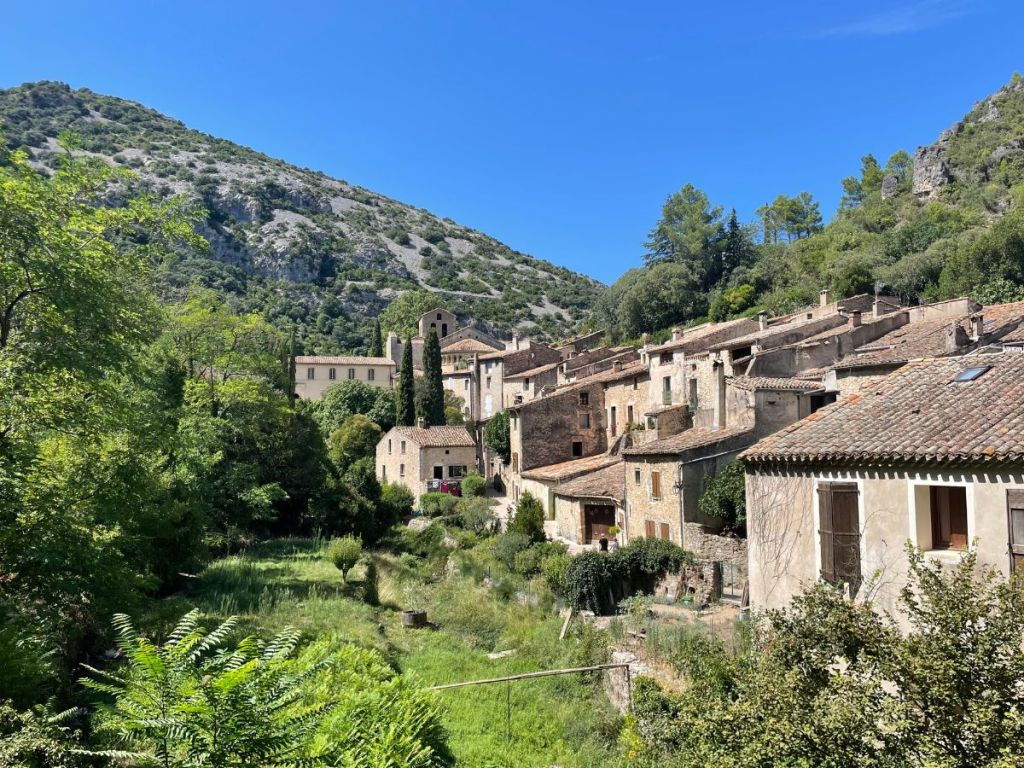
Saint-Guilhem-le-Désert: centuries of faith © Einaz80 — Wikimedia Commons — CC BY-SA 4.0
The Warrior’s Retreat
At Saint-Guilhem-le-Désert, a UNESCO World Heritage Site.
Discover its story
Many New Yorkers are already familiar with this small village of a few hundred inhabitants… Saint Guilhem le Désert, in the heart of the Hérault gorges, is where several magnificent capitals from the abbey’s cloister are now housed at The Cloisters in Manhattan.
Saint-Guilhem-le-Désert is, in fact, first and foremost an abbey and its cloister, listed as a UNESCO World Heritage Site as part of the Routes of Santiago de Compostela in France. Nestled within a stone village on the hillside, it still leaves visitors in awe today. While nothing remains of the original abbey church founded by the legendary William in 804, the building that visitors come to admire is a masterpiece of 11th-century Romanesque art.
By receiving a fragment of the True Cross and William’s remains after his death in 812, the abbey, home to a large monastic community, became an essential stop on the Way of St. James. This William— known in Occitan as Guilhem — had chosen this abbey as a retreat after years of battles fought in the service of his likely relative, Charlemagne. (Charlemagne is one of the key figures in French history: the one crowned emperor in 800 – no French schoolchild is unaware of this, it’s so easy to remember :)).
William became such an important figure in medieval tradition that he later inspired the famous cycle of William of Orange. (More about this in the Literary Connections section.) As always, the construction of the abbey spanned several centuries. It fell into ruin to the point that only a handful of monks remained by the time of the French Revolution.
Early heritage protection efforts helped safeguard the abbey in the 19th century. However, many sculpted stones from the cloister were nevertheless purchased by an American collector in the early 20th century before eventually making their way to Rockefeller and The Cloisters museum in Manhattan.
Saint-Guilhem-le-Désert is also a delightful medieval village built of pale limestone in an impressive setting. Enjoying a drink beneath the monumental plane tree that shades the village square, or strolling through its narrow streets, one cannot help but admire the houses clustered around the abbey, their elegant Renaissance mullioned windows and Gothic lintels. As for the landscape, it is breathtaking: the village sits in a steep-sided valley carved by the erosion of the Hérault River and its tributaries. It reveals limestone hills covered in Mediterranean vegetation, including garrigue, cypress trees, and olive trees, creating a landscape that naturally invites contemplation.
Today, the sisters of the Carmelite Order of Saint Joseph continue to sustain the village’s spiritual and monastic life.
Interested in visiting Saint Guilhem le Désert? You can do it from Montpellier…
→ Find a selection of guided tours and activities
If you book through this link, I may receive a small commission at no extra cost to you.
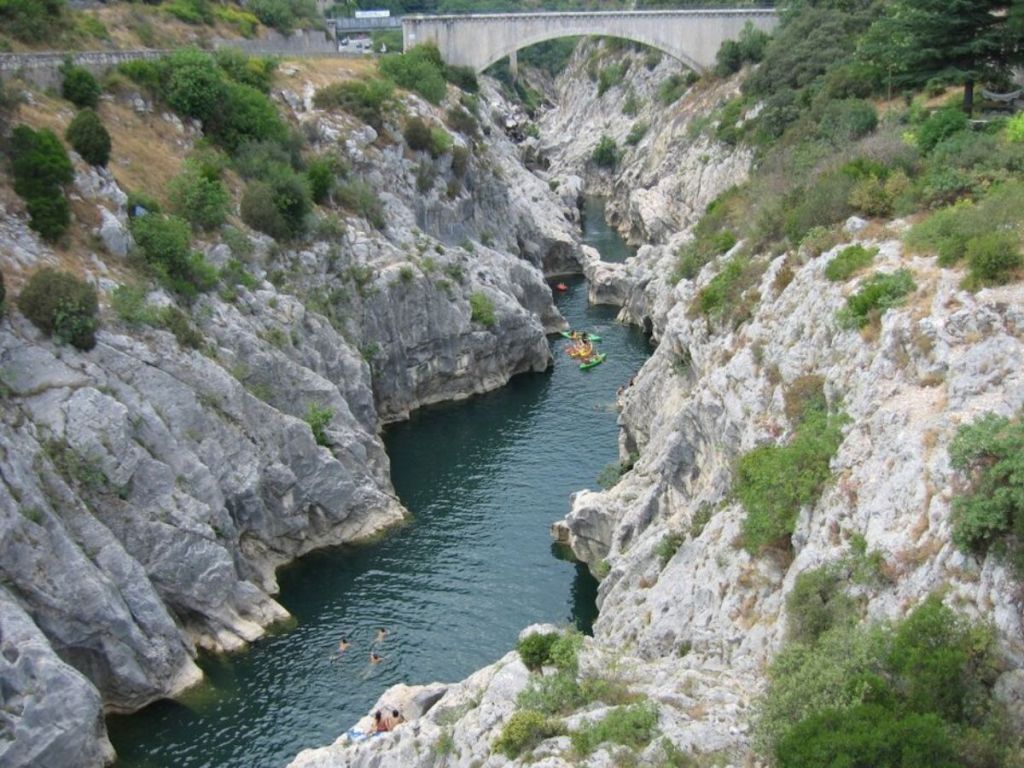
The Hérault Gorges: paddling through ancient limestone walls © Wikimedia Commons
Saint-Guilhem-le-Désert and the Hérault Gorges: Turquoise waters in a spectacular setting.
Discover its story
Near Saint-Guilhem-le-Désert, one can easily find swimming spots as well as canoe and kayak rentals. One of the highlights of this section of the river, between the Pont du Diable (Devil’s Bridge) and the entrance to the village, is the Clamouse Cave, whose astonishing stalactites are well worth a visit.
Hiking enthusiasts will find numerous trails offering breathtaking views over the Hérault Gorges and the surrounding limestone hills. Those looking for a more leisurely experience can enjoy a pleasant walk along the Passerelle des Anges, designed by architect Rudy Ricciotti and inaugurated in 2009, leading to the Pont du Diable, a superb 11th-century stone bridge that should not be missed.
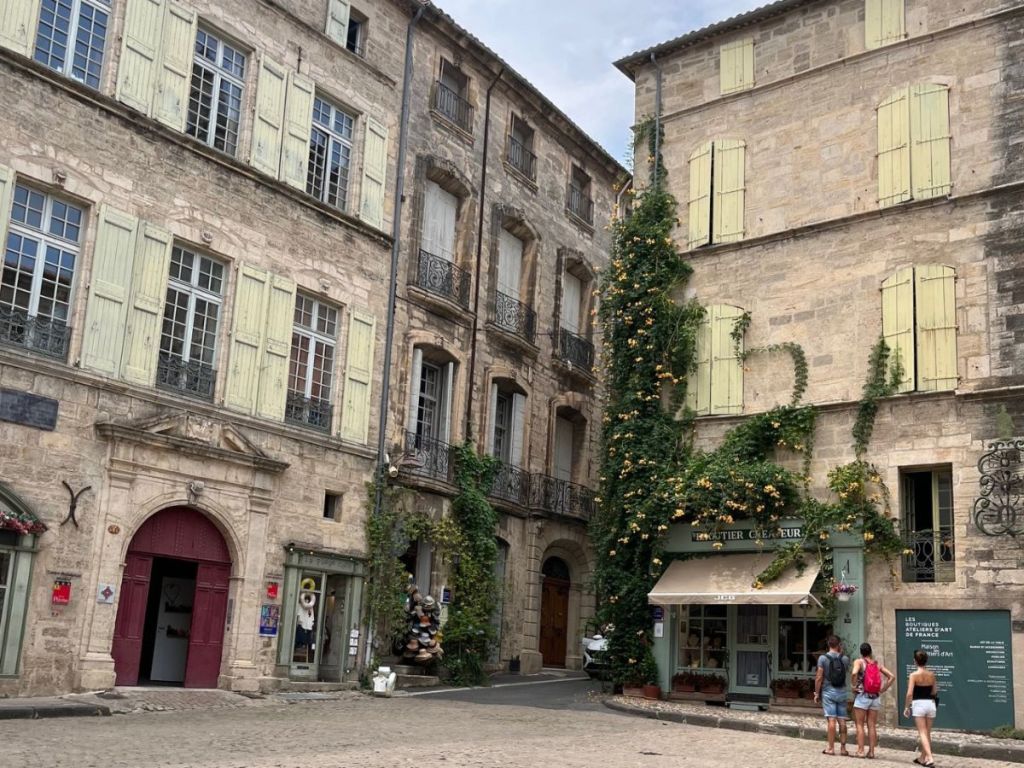
A square in the old town of Pézenas ©Algoma
Pézenas: A Beauty Out of Time
Located just a few kilometers from Béziers in Southern France, the town of Pézenas boasts a rich history, particularly during the medieval period and the 17th and 18th centuries.
Discover its story
Visitors can spend hours strolling through the old town—following routes suggested by the Tourist Office—and encounter numerous traces of past splendor along the way, including beautifully preserved facades of grand townhouses (“hôtels particuliers”).
The town’s regional importance dates back in part to the 13th century, when its fairs attracted merchants from France and neighboring countries, particularly Italy and Spain. However, the fairs at Beaucaire—in the nearby Gard department—eventually rivaled those of Pézenas, contributing to a decline in the town’s economic activity.
A revival came in the 16th century thanks to the Montmorency family, particularly at the turn of the century, followed in the 17th century by the arrival of a member of the royal family: Armand de Bourbon, Prince of Conti. It was he who welcomed and patronized the actor and playwright Jean-Baptiste Poquelin—better known as Molière—during the early years of his theatrical career.
Today, the old town looks almost untouched and seems to have escaped many of the urban and economic transformations brought about by the Industrial Revolution and the era of unbridled economic expansion, especially as it was bypassed by the main railway lines.
So, if you’re not driving, you’ll need to take a bus. This is easy to do—for example, from Agde—and offers a wonderful opportunity to travel through the lovely vineyard landscapes of the Picpoul de Pinet region.
Interested in visiting Pézenas?
→ Find a selection of guided tours and activities
If you book through this link, I may receive a small commission at no extra cost to you.
Want to explore further?
For a city that pulses with youth and southern light, explore Montpellier…
For a coastline unlike any other, discover the Coast & the Thau Lagoon…
Just next door, to the east, a land where Rome never left and nature still runs wild — discover the Gard…
To the west, a land of wonders — discover the Aude…
 Algoma