
Welcome to Nîmes – The French Rome
If you’re planning a trip to the South of France, Nîmes is one of the best places to visit. Often called the French Rome, the city is a hidden gem — and one the world is starting to notice: in 2023, its Maison Carrée earned UNESCO World Heritage status, and the New York Times ranked Nîmes among its 50 best destinations. Its Roman monuments fit naturally into the charming city streets, while centuries of history leave their mark in every corner. From 18th‑century denim fame to lively ferias today, Nîmes blends the past and present in a relaxed and sunny atmosphere.
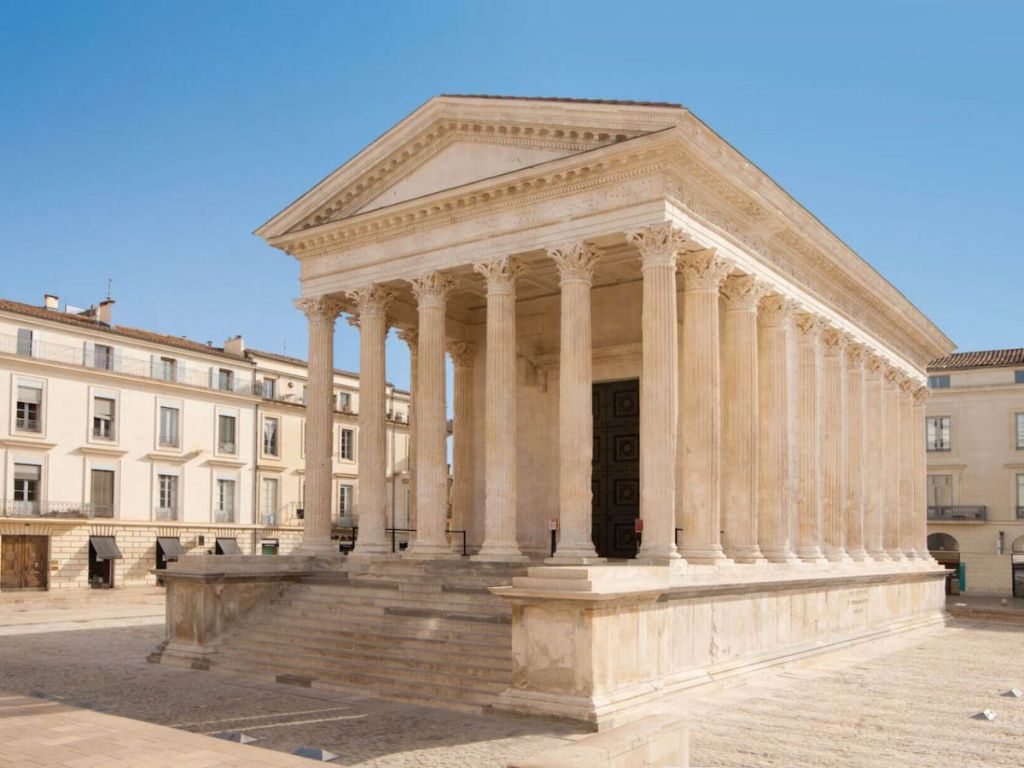
Maison Carrée © Nîmes Tourisme
La Maison Carrée: One of the best-preserved Roman temples in the world.
Discover its story
Among the top things to do in Nîmes, visiting the Maison Carrée is an essential first step into the city’s Roman history.
Built during the reign of Augustus, the Maison Carrée stands at the heart of Nîmes, its elegant proportions and golden stone reflecting the refinement of Roman architecture.
Positioned where the Via Domitia changes direction, the Maison Carrée is a remarkably well-preserved Roman temple. Despite its name, it is rectangular in shape and was completed during the reign of Augustus. Over time, the stone has developed a warm golden hue, giving the monument a surprising softness. While the interior can be visited, the true beauty of the site lies in its exterior — a masterpiece of balance and harmony that has inspired architects in Nîmes for centuries.
As one of the most iconic Roman sites in France, it offers a striking introduction to the ancient heritage that defines this city in the South of France.
Interested in visiting Nîmes?
→ Explore guided tours and experiences
If you book through this link, I may receive a small commission at no extra cost to you.
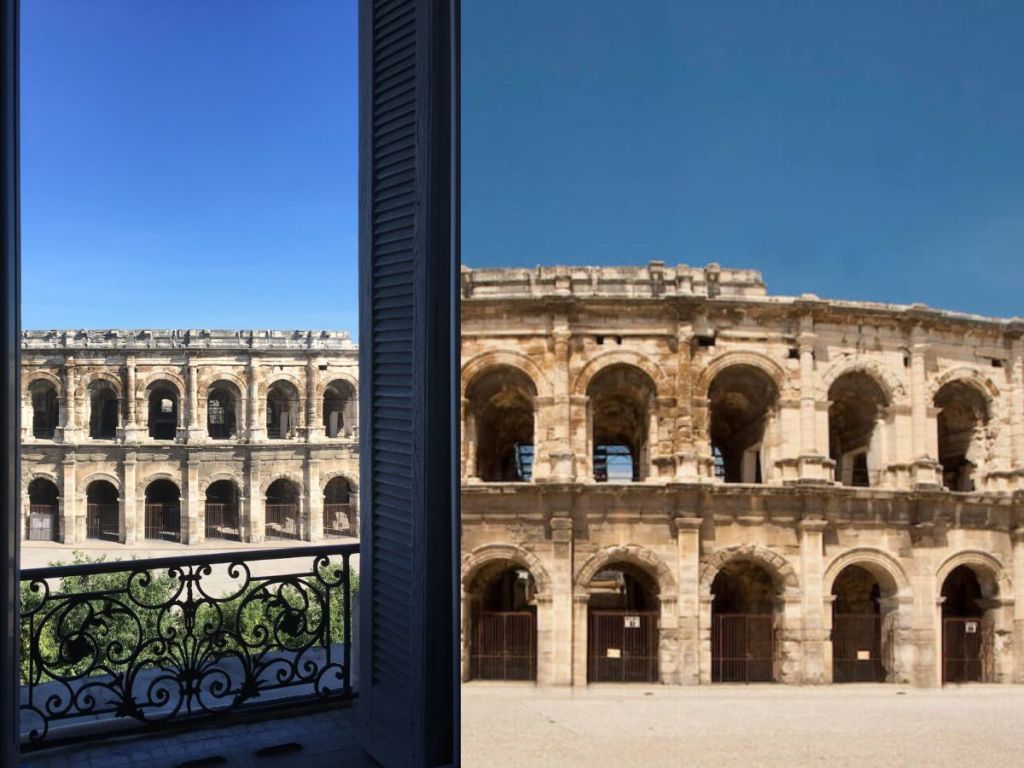
Nîmes Arena © Nîmes Tourisme
Arena of Nîmes: A spectacular legacy of Roman entertainment.
Discover its story
Another must-see among the best things to do in Nîmes, the Arena brings Roman history vividly to life.
Dating back to the 1st century AD, this remarkably preserved amphitheater still hosts events today. Walking through its corridors offers a striking understanding of the scale and ingenuity of Roman public life.
Built at the height of the Roman Empire, the Arena of Nîmes is one of the best-preserved amphitheaters in the world. Designed to host large-scale spectacles, it once welcomed thousands of spectators eager for dramatic performances and public games.
Today, the monument remains very much alive, with concerts and traditional events still taking place within its ancient walls. Watching a performance here – or simply visiting – offers a powerful sense of continuity, with past and present quietly meeting around you in a truly unique setting.
Interested in visiting the Arena of Nîmes?
→ Explore guided tours and experiences
If you book through this link, I may receive a small commission at no extra cost to you.

Musée de la Romanité © Nîmes Tourisme
Musée de la Romanité: A modern gateway to the ancient world.
Discover its story
To better understand the Roman history of Nîmes, this museum is an essential stop during your South of France travel itinerary.
Opened in 2018 and designed by architect Elizabeth de Portzamparc, the museum offers an engaging journey through the Roman history of Nîmes and its region.
One of Nîmes’ most recent landmarks, the Musée de la Romanité provides a deeper understanding of the city’s ancient past. Through immersive displays and carefully curated collections, it traces the evolution of Nîmes and its surrounding region during the Roman era.
The museum brings to life the ingenuity behind iconic sites such as the Arena of Nîmes and the Pont du Gard, offering visitors a richer perspective on the monuments you’ll encounter throughout the city. Highly enjoyable, it is a perfect complement to exploring Nîmes and its surroundings.
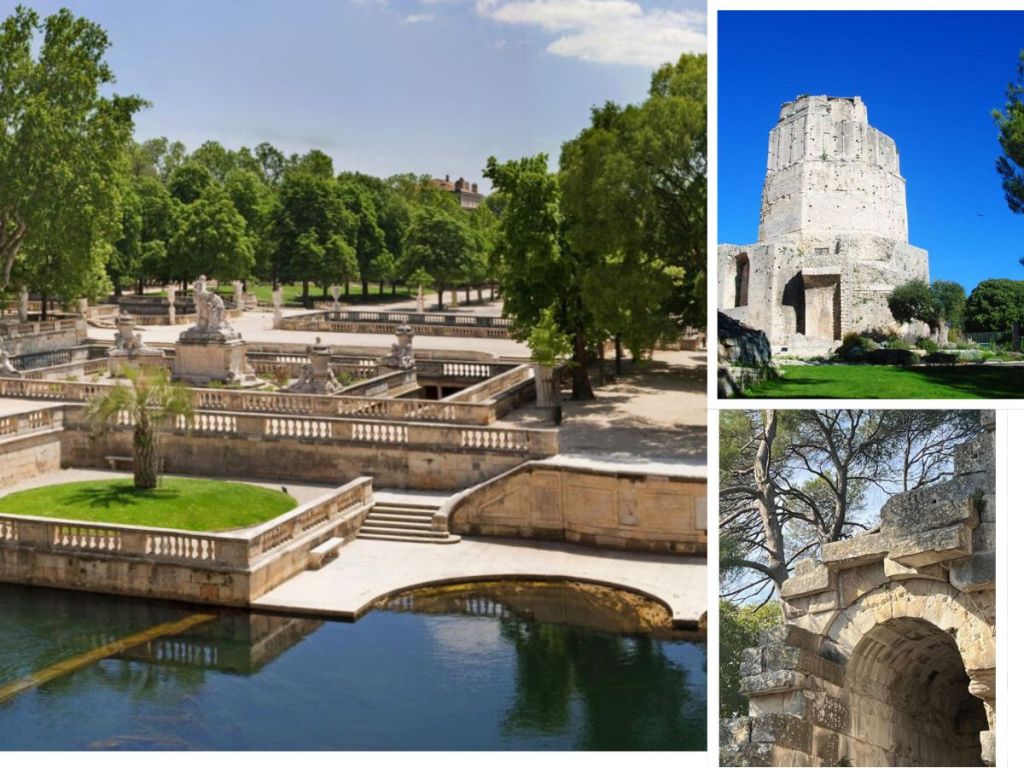
Jardins de la Fontaine, Tour Magne and Temple of Diana in Nîmes © Nîmes Tourisme/Algoma
Jardins de la Fontaine & Tour Magne: A peaceful retreat shaped by history and nature.
Discover its story
If you’re looking for scenic places in the South of France, this peaceful garden offers one of the most relaxing experiences in Nîmes. From elegant French gardens to shaded paths leading up to the Tour Magne, this unique site reveals the origins of the city while offering one of the most beautiful walks in Nîmes.
Rising above the city from one of its highest points, the Tour Magne is one of Nîmes’ most striking landmarks. Built on the remains of an earlier Gallic structure, it is the best-preserved of the eighty towers that once formed the Roman city walls under Emperor Augustus. Its powerful silhouette, shaped by time, has watched over Nîmes for centuries — even serving as a lookout during World War II.
At its foot lie the Jardins de la Fontaine, a place that feels both historic and timeless. Created in the 18th century around the spring that gave birth to the city, the gardens combine formal French design with more natural, romantic landscapes as you wander further in.
As you stroll through shaded paths and terraces, you’ll come across the evocative ruins of the Temple of Diana before gradually reaching higher viewpoints and quieter corners. With its Mediterranean vegetation, gentle light and sense of calm, the gardens offer a refreshing escape in every season — and one of the most memorable walks in Nîmes.
Interested in visiting Nîmes?
→ Explore guided tours and experiences
If you book through this link, I may receive a small commission at no extra cost to you.

Nîmes and denim a long story © Algoma
The Story of Denim: A surprising link between Nîmes and America.
Discover its story
If you’ve ever worn a pair of jeans —chances are you have — did you know may have already carried a small piece of Nîmes with you… ? This story adds an unexpected layer to your visit, connecting Nîmes to American history in a way few can anticipate.
If you love France, you’ll enjoy this story. For centuries, the city of Nîmes was known for producing a strong fabric, originally made from a blend of wool and silk.
By the 18th century, this textile was exported to the United States “de Nîmes” via the port of Genoa — “de Gênes” in French. Over time, these names are believed to have evolved into the words we use today: “denim” and “jeans.”
It was then popularized in America by Levi Strauss, who reinforced the fabric with copper rivets, creating the durable garment that would become a global icon.
Parts of this story are still debated today, but its charm remains undeniable — and isn’t it nice to think that, when you wear a pair of jeans, you’re carrying a little piece of France with you… ?
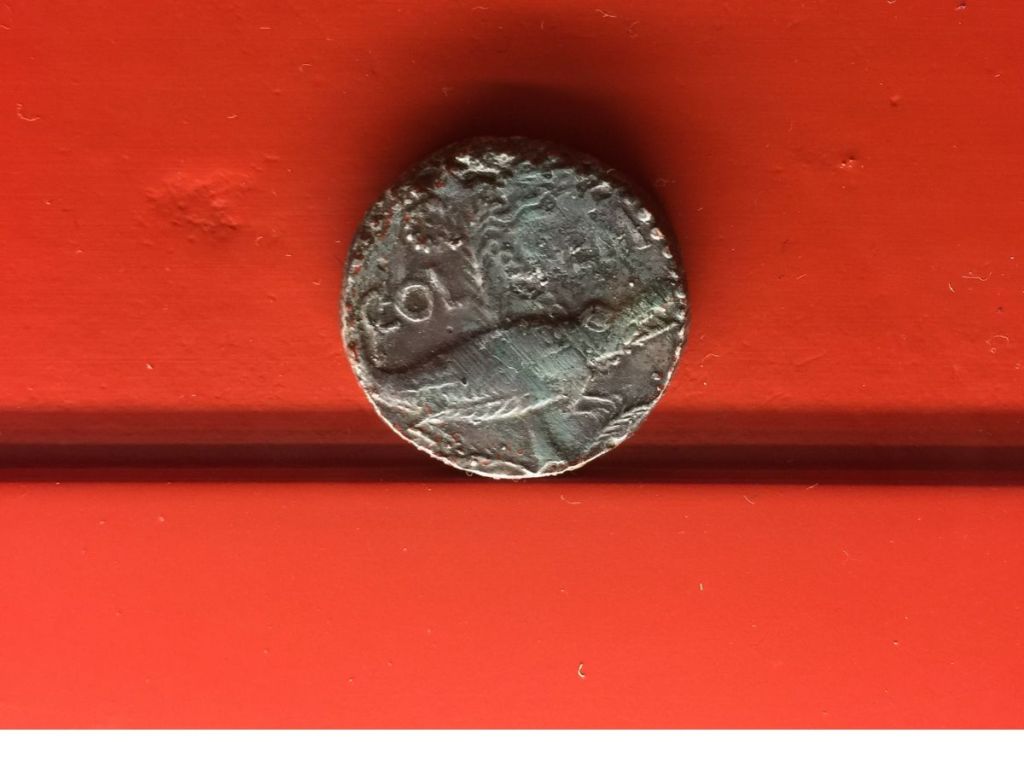
The crocodile and its palm tree — Nîmes’ ancient emblem since Roman times © Algoma
The Crocodile and Its Palm Tree: A symbol you’ll start noticing everywhere in Nîmes.
Discover its story
Details like this are part of what makes Nîmes one of the most fascinating hidden gems in the South of France.
As you explore the city, you’ll soon spot the crocodile and palm tree motif throughout the city — on medallions, sculptures and small details beneath your feet. Reinterpreted by the French designer Philippe Starck, it originates from a Roman coin celebrating Augustus’ victory over Antony and Cleopatra at the Battle of Actium. The crocodile, symbolizing Egypt, is chained to a palm tree — a sign of triumph.
In the 16th century, Francis I of France adopted this emblem as the city’s coat of arms. You can still see it in sculpted form at the Place du Marché, and it has since become a defining symbol of Nîmes.
Today, the crocodile is embraced as the city’s mascot — and one of its most curious sights awaits inside the Town Hall, where four stuffed crocodiles from 16th, 17th, and 18th centuries hang in the grand staircase.
It’s a small detail — but one that tells a surprisingly rich story, and one you won’t forget once you start noticing it.
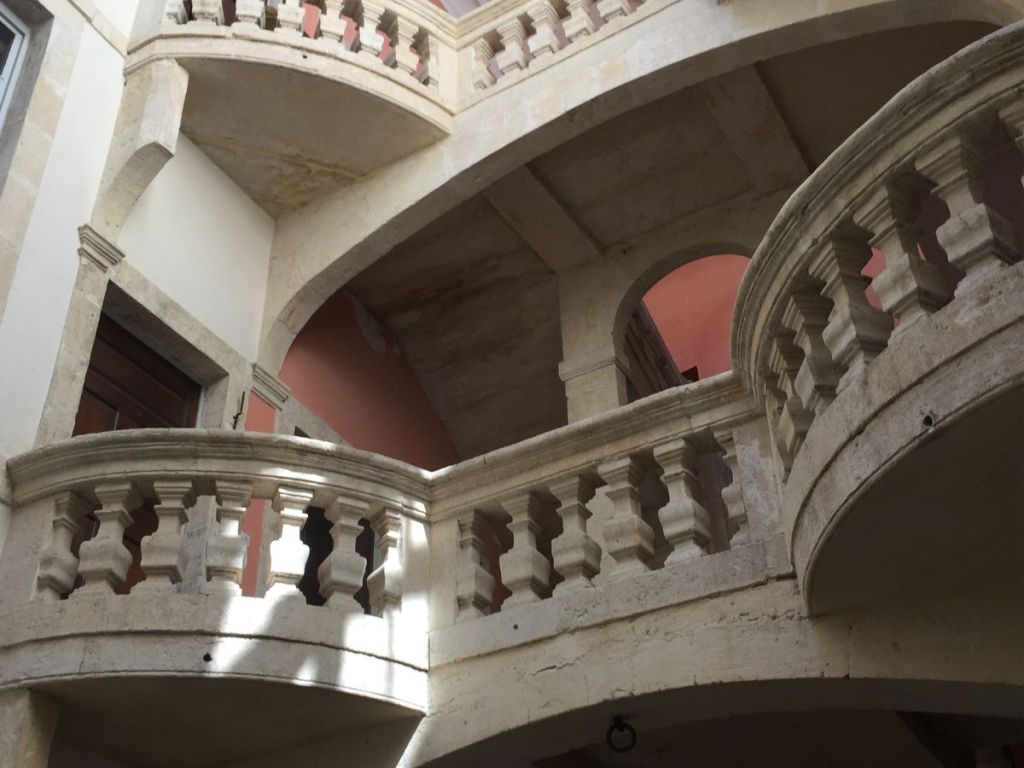
Hôtel de Fontfroide staircase © Algoma
Private Mansions & the City’s Golden Age: A glimpse into the refined lifestyle of Nîmes’ past.
Discover its story
Wandering through these streets is one of the most rewarding things to do in Nîmes for travelers interested in architecture and local history.
As you stroll through the Écusson — the historic heart of Nîmes, named for its shield-like shape — you’ll notice the elegant façades of private mansions built between the 16th and 18th centuries by the city’s aristocracy and wealthy merchants.
Built upon earlier structures, these residences reveal a deep admiration for Roman architecture. Classical elements — such as triangular and rounded pediments inspired by nearby monuments — appear throughout, creating a subtle dialogue between ancient and more recent styles.
The compact layout of the old town challenged architects to make the most of limited space, resulting in remarkably inventive designs. Today, this architectural richness can be discovered along a handful of pedestrian streets, ideal for a relaxed and rewarding walk.
To experience these mansions more fully — and step inside their hidden courtyards — guided visits are available through the local tourist office, offering a deeper look into this chapter of Nîmes’ history.
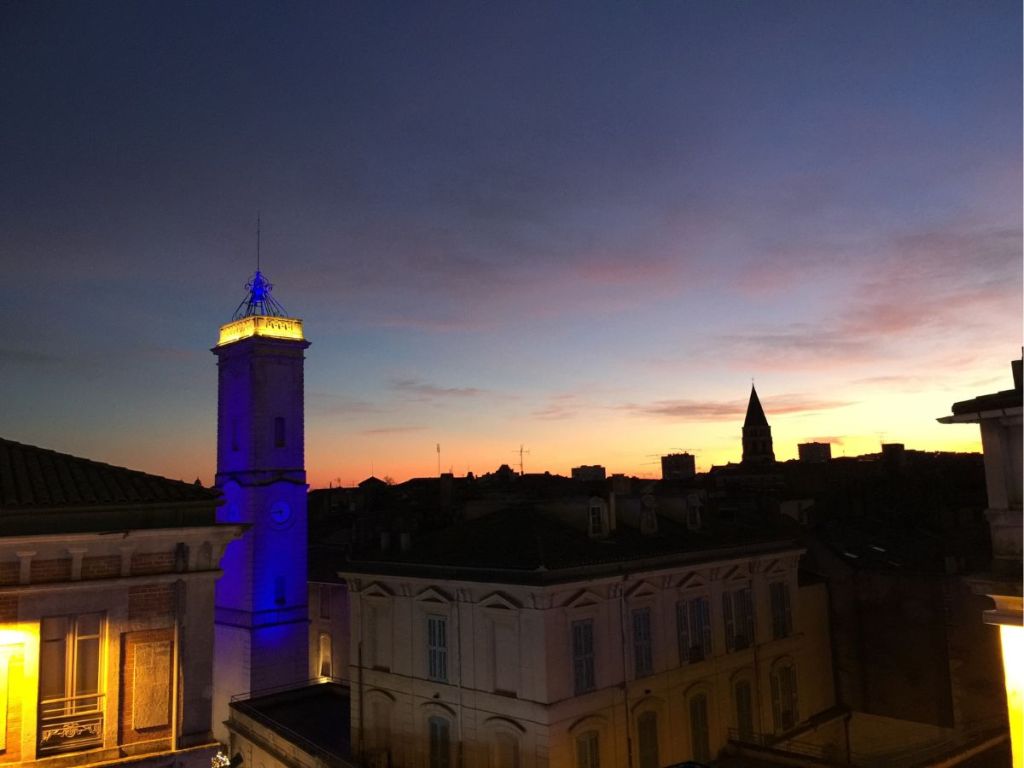
Nîmes by night — the Clock Tower rising above the rooftops © Algoma
The Cathedral and the Clock Tower, witnesses to the city’s turbulent history.
Discover its story
Nîmes is often called the “French Rome,” but in the 16th century it was also known as “Little Geneva,” reflecting the strong presence of Protestantism in this part of France — an area once referred to as the “Croissant Réformé” (“Reformed Crescent”) a name inspired by… its shape! rather than any connection to the famous pastry.
This dual religious identity came at a cost, leaving a lasting mark on the city’s history — one that can still be felt today.
As you explore Nîmes, you’ll notice both Catholic churches and Protestant temples, sometimes in unexpected places — including former convents, such as the small temple on Rue du Grand Couvent, a detail that hints at the city’s complex past.
At the heart of it all stands the Notre-Dame-et-Saint-Castor Cathedral, where life in Nîmes has unfolded for over a thousand years. First consecrated in 1095 by Pope Urban II, it was destroyed and rebuilt several times before taking its present form in the 17th century.
Just steps away, the Clock Tower on Place de l’Horloge tells another story. Built in 1752, it once housed the city’s main clock, moved here from the cathedral so that time could be marked for daily life — not only for religious services, but also for the rhythm of commerce and, notably, the wine trade.
Together, these landmarks offer more than architectural interest — they reveal the layered, sometimes turbulent history that has shaped the identity of Nîmes, and still echoes through its streets today.
This layered history makes Nîmes a particularly compelling destination for those exploring historic towns in the South of France.
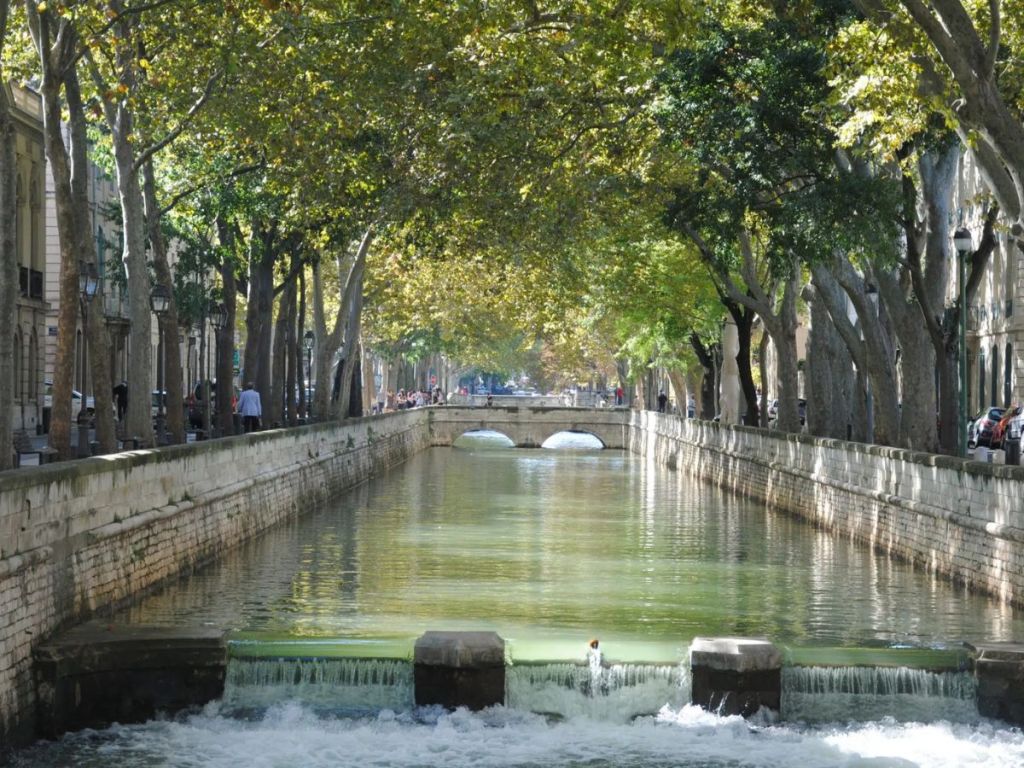
Canal de la Fontaine in Nîmes © Nîmes Tourisme
Water: the force behind Nîmes’ prosperity.
Discover its story
During your walk through the Jardins de la Fontaine, you encountered the very source that gave birth to Nîmes — a precious supply of water in a city with no river and far from the sea. Understanding this relationship with water helps explain how Nîmes developed into one of the most important Roman cities in southern France.
Beneath the hill, a complex network of fissures and underground channels brings the spring to the surface in the Jardin de la Fontaine. It was in the 18th century that local manufacturers and cloth merchants sought to better control and use this resource.
The water was carefully channeled and divided: one branch powered flour mills along the city walls, while another supplied workshops where textiles were washed and dyed. A precise and highly skilled process emerged, moving from delicate silks to richer colors, before reaching wool and cotton dyed in vivid natural pigments.
Even today, traces of this industrial past can be found in the city’s street names: Rue Nationale, formerly Rue de l’Agau (derived from the word “l’Aigüe,” meaning water), Rue de la Gaude, named after a plant renowned since the Middle Ages for its high-quality yellow dye, or Rue des Tondeurs, referring to the area where cloth shearers worked, a profession requiring refined training.
Today, water still flows, but underground, as these waterways no longer serve this purpose and have been covered over by houses and the city.
Only the beautiful canal remains, leading from the Jardins de la Fontaine to the city center, lined with magnificent 18th- and 19th-century houses you are sure to come across and admire during your stroll.
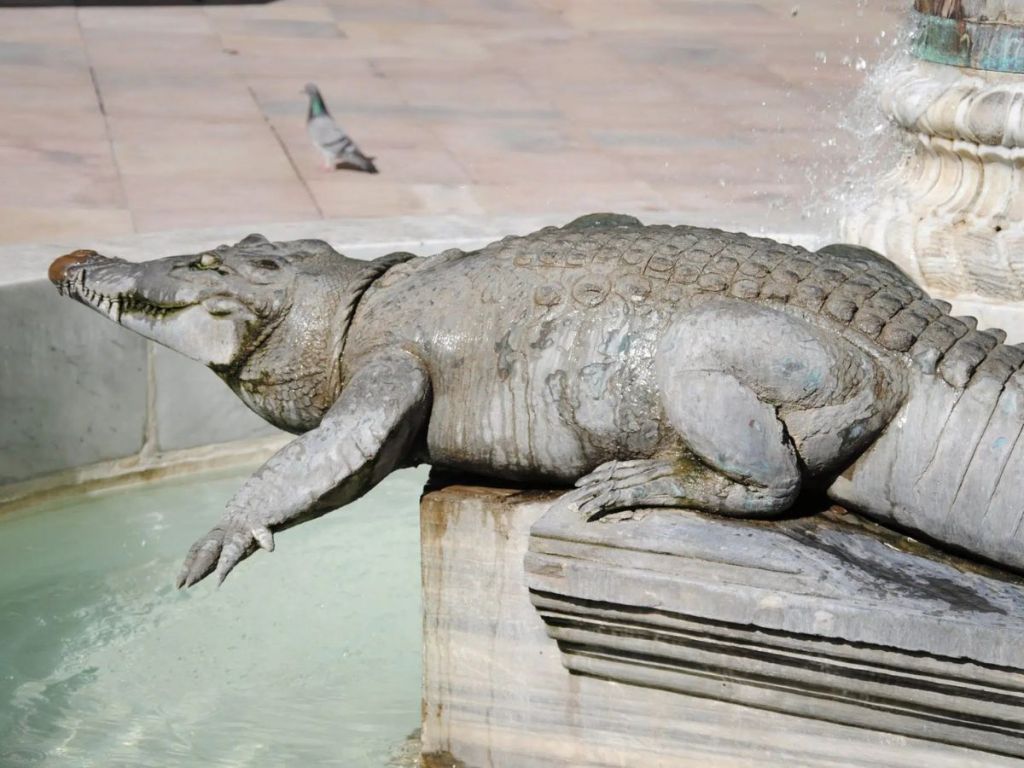
The crocodile fountain by Martial Raysse — Nîmes’ symbol reinvented © Nîmes Tourisme
Nîmes, a city also shaped by modern architects and designers.
Discover its story
Today, this blend of old and new makes Nîmes one of the most unique cities to visit in the south of France.
As you explore Nîmes, you may be surprised to discover how naturally contemporary architecture blends with its Roman heritage. The city continues to invite renowned architects to reinterpret its past while embracing the present.
This dialogue between eras can be seen throughout the city. The Musée de la Romanité was designed by Elizabeth de Portzamparc, while Norman Foster created the Carré d’Art, a striking modern art museum facing the Maison Carrée. Jean-Michel Wilmotte redesigned the Halles de Nîmes, now a lively destination for food lovers, and Jean Nouvel contributed bold contemporary housing recognized as 20th-century heritage and still fascinating young architects today.
Even the city’s emblem continues to evolve. Artist Martial Raysse reimagined the famous crocodile on Place du Marché, while Philippe Starck created a modern version that you’ll notice subtly embedded in small medallions beneath your feet as you walk through the city.
In Nîmes, architecture is not frozen in time — it creates a continuous conversation between past and present, one you’ll experience as you move from one landmark to another.
Want to explore further?
If you have more time, explore these best day trips from Nîmes…
For a different landscape, head to the Camargue…
If nature calls, follow the trails of the Cévennes…
Just next door, a coast of lagoons, cities full of life, ancient stones and vineyards as old as time — discover the Hérault…
A step further, the Aude opens the door to a land of wonders…
 Algoma